
Servo CNC Controllers
Description
Servo CNC Controllers are sophisticated devices used to control the motion of servo motors in CNC (Computer Numerical Control) systems. These controllers manage the precise movement and positioning of the motors, ensuring that the desired motion profiles are achieved with high accuracy and efficiency.
Working Principle
Servo CNC Controllers operate by utilizing feedback mechanisms to control the position, velocity, and acceleration of servo motors. They typically incorporate an encoder, which provides real-time feedback on the motor's position. This feedback is processed by the controller, which adjusts the motor's operation to maintain the desired motion profile. The use of network-based architectures in modern servo systems enhances diagnostic capabilities and reduces implementation costs, making them highly efficient and reliable for complex machinery operations .
Applications
Servo CNC Controllers are widely used in various applications that require precise motion control. Specific examples include robotics, where they manage the intricate movements of robotic arms, and process automation systems, where they ensure the accurate positioning of components in manufacturing processes .
Advantages over other CNC Controllers
One significant advantage of Servo CNC Controllers is their ability to prevent lost steps, a common issue with traditional step motors. By using an encoder to determine the motor's position, Servo CNC Controllers eliminate the problem of losing steps, ensuring more reliable and accurate operation. Additionally, they generate less heat due to more efficient operation, as they only output the necessary torque for the desired motion profile, unlike traditional step motors that operate at a constant current .
Limitations
While Servo CNC Controllers offer numerous benefits, they also have limitations. The complexity of their setup and the need for precise calibration can be challenging, requiring skilled personnel for installation and maintenance. Additionally, the initial cost of implementing a servo system can be higher compared to simpler motor control systems.
Considerations
When considering Servo CNC Controllers, it is essential to evaluate several factors. Initial costs can be significant due to the advanced technology and components involved. However, the long-term operating expenses may be lower due to increased efficiency and reduced downtime. Durability and accuracy are generally high, but regular maintenance is necessary to ensure optimal performance. Replacement and maintenance costs should also be factored into the overall cost analysis, as these can vary depending on the complexity of the system and the specific application requirements.
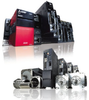
from Mitsubishi Electric Automation, Inc.
With the outstanding performance of the first CNC-dedicated CPU, and the expandability of the iQ-R platform, the C80 CNC controller opens up endless opportunities for production line machining worldwide. Key Benefits. CNC-dedicated CPU – Improved cycles times due to faster program processing... [See More]
- Motor: Servo
- Number of Axes: 1 Axis; 2 Axes; 3 Axes; 4 Axes; 5 Axes; 6+ Axes
- Applications: Lathes and Turning Centers; Complete Machine Retrofit
- Configuration: Stand Alone; Integral Display
from Hypertherm, Inc.
The Sensor THC is a full featured torch height control system specifically designed to integrate with Hypertherm Automation's shape cutting controls. [See More]
- Motor: Servo
- Configuration: Desktop
- Applications: Torch Table
- Control Function: Torch Height Controls
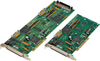
from Galil
The DMC-18x0 PCI motion controller is a member of the Optima Series, Galil's prior-generation, multi-axis motion controllers. The DMC-18x0 controller accommodates 1- through 8-axis formats and allows control of step or servo motors on any combination of axes. Any mode of motion can be programmed... [See More]
- Motor: Servo; Stepper
- Number of Axes: 1 Axis
- Applications: Horizontal Mills; Vertical Mills; Lathes and Turning Centers; Grinders; Electro-Discharge Machine; Torch Table; Welding; Inspection
- Configuration: Computer Board

from Mitsubishi Electric Automation, Inc.
The Q173NCCPU enables CNC Control to be integrated with Sequence, Motion, and Robot automation systems. Also known as the C70 Series CNC Controller, an iQ CNC CPU system uses multi-purpose GOT1000 HMIs and on-rack I/O cards to minimize TCO on CNC line solutions. Key Features: Accelerated... [See More]
- Motor: Servo
- Number of Axes: 1 Axis; 2 Axes; 3 Axes; 4 Axes; 5 Axes; 6+ Axes
- Applications: Lathes and Turning Centers; Complete Machine Retrofit
- Configuration: Stand Alone; Integral Display
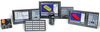
from Mitsubishi Electric Automation, Inc.
Vernon Hills, Illinois, July 10, 2013 - As an innovator of factory automation technology, Mitsubishi Electric Automation, Inc., continues to meet market demand for higher production output rates with the introduction of the M70V Series computer numerical controllers (CNC). The M70V Series, part of... [See More]
- Motor: Servo
- Number of Axes: 1 Axis; 2 Axes; 3 Axes; 4 Axes; 5 Axes; 6+ Axes
- Applications: Lathes and Turning Centers; Complete Machine Retrofit
- Configuration: Stand Alone; Integral Display

from Mitsubishi Electric Automation, Inc.
The M700V Series is designed to provide productivity and operating ease. The M700V Series features nano-control technology to meet the needs of a new era, and also incorporates an original high-speed servo network. As Mitsubishi's flagship machining center, the M700V Series continues to deliver... [See More]
- Motor: Servo
- Number of Axes: 1 Axis; 2 Axes; 3 Axes; 4 Axes; 5 Axes; 6+ Axes
- Applications: Lathes and Turning Centers; Complete Machine Retrofit
- Configuration: Stand Alone; Integral Display; Touch Screen (optional feature)