
2 CNC Controllers
Description
CNC controllers are integral components of CNC machines, responsible for managing the machine's operations. They interpret G-code instructions to control the movement and operation of machine tools, enabling precise manufacturing processes. These controllers can be configured in various forms, such as computer boards, stand-alone cabinets, or desktop controllers, and may include features like alarms, event monitoring, and multi-program storage.
Working Principle
CNC controllers operate by executing a series of programmed instructions, typically written in G-code, which dictate the movements and functions of the machine tool. The controller processes these instructions to control the machine's axes, spindle speed, and other operational parameters. This automation allows for high precision and repeatability in manufacturing processes, making CNC controllers essential for producing complex and intricate parts.
Applications
CNC controllers are used in a wide range of applications across various industries. They are commonly employed in machine tools such as milling machines, lathes, and drilling machines. Specific examples include precision grinding machines, electro-discharge machining (EDM) machines, and sheet metal working machines like turret punching machines. They are also used in fabrication equipment, including flame cutting and welding machines.
Advantages over other CNC Controllers
CNC controllers offer several advantages over traditional manual control methods. They provide high productivity by reducing the time required for setup and operation, as they can rapidly traverse and position between operations. CNC controllers also offer design flexibility, allowing for the production of complex shapes without the need for expensive jigs and fixtures. Additionally, they maintain a constant rate of productivity and can operate continuously without fatigue.
Limitations
Despite their advantages, CNC controllers have limitations. The initial cost of CNC machines can be high, and they require skilled operators for programming and maintenance. Additionally, the complexity of programming can lead to errors if not managed properly. The need for regular maintenance and potential downtime for repairs can also impact productivity.
Considerations
When selecting a CNC controller, several factors should be considered. Initial costs can be significant, but they are often offset by increased productivity and reduced labor costs. Operating expenses include energy consumption and maintenance costs, which can vary depending on the complexity and usage of the machine. Durability and accuracy are critical factors, as they directly impact the quality of the manufactured parts. Replacement and maintenance costs should also be considered, as they can affect the overall cost-effectiveness of the CNC system.
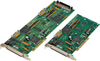
from Galil
The DMC-18x0 PCI motion controller is a member of the Optima Series, Galil's prior-generation, multi-axis motion controllers. The DMC-18x0 controller accommodates 1- through 8-axis formats and allows control of step or servo motors on any combination of axes. Any mode of motion can be programmed... [See More]
- Number of Axes: 2 Axes
- Motor: Servo; Stepper
- Applications: Horizontal Mills; Vertical Mills; Lathes and Turning Centers; Grinders; Electro-Discharge Machine; Torch Table; Welding; Inspection
- Configuration: Computer Board
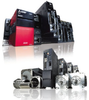
from Mitsubishi Electric Automation, Inc.
With the outstanding performance of the first CNC-dedicated CPU, and the expandability of the iQ-R platform, the C80 CNC controller opens up endless opportunities for production line machining worldwide. Key Benefits. CNC-dedicated CPU – Improved cycles times due to faster program processing... [See More]
- Number of Axes: 1 Axis; 2 Axes; 3 Axes; 4 Axes; 5 Axes; 6+ Axes
- Motor: Servo
- Applications: Lathes and Turning Centers; Complete Machine Retrofit
- Configuration: Stand Alone; Integral Display

from Mitsubishi Electric Automation, Inc.
The Q173NCCPU enables CNC Control to be integrated with Sequence, Motion, and Robot automation systems. Also known as the C70 Series CNC Controller, an iQ CNC CPU system uses multi-purpose GOT1000 HMIs and on-rack I/O cards to minimize TCO on CNC line solutions. Key Features: Accelerated... [See More]
- Number of Axes: 1 Axis; 2 Axes; 3 Axes; 4 Axes; 5 Axes; 6+ Axes
- Motor: Servo
- Applications: Lathes and Turning Centers; Complete Machine Retrofit
- Configuration: Stand Alone; Integral Display
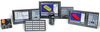
from Mitsubishi Electric Automation, Inc.
Vernon Hills, Illinois, July 10, 2013 - As an innovator of factory automation technology, Mitsubishi Electric Automation, Inc., continues to meet market demand for higher production output rates with the introduction of the M70V Series computer numerical controllers (CNC). The M70V Series, part of... [See More]
- Number of Axes: 1 Axis; 2 Axes; 3 Axes; 4 Axes; 5 Axes; 6+ Axes
- Motor: Servo
- Applications: Lathes and Turning Centers; Complete Machine Retrofit
- Configuration: Stand Alone; Integral Display