
3 CNC Controllers
Description
CNC controllers are devices that manage the operation of CNC machines by interpreting G-code and M-code to control the machine's movements and functions. They can be configured as computer boards, housed in stand-alone cabinets, or integrated into desktop, rack-mounted, pendant, or pedestal setups. These controllers often include features such as alarms, event monitoring, and multi-program storage.
Working Principle
CNC controllers operate by using a programming language, primarily G-code, to direct the machine's actions. The controller interprets these codes to perform precise movements and operations, such as cutting or shaping materials. This automation allows for high precision and repeatability, making CNC controllers essential for complex manufacturing tasks. They are useful because they can execute complex algorithms involving multiple axes of control, which enhances the efficiency and accuracy of manufacturing processes.
Applications
CNC controllers are widely used in various industries for applications such as milling, turning, and drilling. Specific examples include their use in machine tools like milling machines and machining centers, center lathes and turning centers, and precision grinding machines. They are also employed in sheet metal working machines, such as turret punching machines and riveting machines, as well as in fabrication equipment like flame cutting and welding machines.
Advantages over other CNC Controllers
CNC controllers offer several advantages over traditional manual machines. They provide high productivity by reducing the time needed for operations through rapid traversing and positioning. CNC machines can perform a wider range of operations without the need for multiple machines, which reduces the need for expensive jigs and fixtures. Additionally, CNC machines maintain a constant rate of productivity and can operate continuously without fatigue, especially when robot-fed.
Limitations
One limitation of CNC controllers is the initial cost, which can be high due to the complexity and precision of the equipment. Additionally, the programming of CNC machines can be complex and requires skilled operators. There may also be compatibility issues with different programming languages, as various manufacturers have developed their own languages, which can complicate the integration of different machines within a single production environment.
Considerations
When considering CNC controllers, it is important to evaluate the initial costs, which can be significant. Operating expenses should also be considered, as CNC machines require regular maintenance and skilled operators. Durability and accuracy are critical factors, as these machines must maintain precision over long periods. Replacement and maintenance costs can also add up, so it's essential to factor these into the overall cost of ownership.
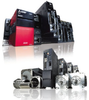
from Mitsubishi Electric Automation, Inc.
With the outstanding performance of the first CNC-dedicated CPU, and the expandability of the iQ-R platform, the C80 CNC controller opens up endless opportunities for production line machining worldwide. Key Benefits. CNC-dedicated CPU – Improved cycles times due to faster program processing... [See More]
- Number of Axes: 1 Axis; 2 Axes; 3 Axes; 4 Axes; 5 Axes; 6+ Axes
- Motor: Servo
- Applications: Lathes and Turning Centers; Complete Machine Retrofit
- Configuration: Stand Alone; Integral Display
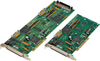
from Galil
The DMC-18x0 PCI motion controller is a member of the Optima Series, Galil's prior-generation, multi-axis motion controllers. The DMC-18x0 controller accommodates 1- through 8-axis formats and allows control of step or servo motors on any combination of axes. Any mode of motion can be programmed... [See More]
- Number of Axes: 3 Axes
- Motor: Servo; Stepper
- Applications: Horizontal Mills; Vertical Mills; Lathes and Turning Centers; Grinders; Electro-Discharge Machine; Torch Table; Welding; Inspection
- Configuration: Computer Board
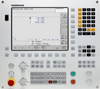
from DR. JOHANNES HEIDENHAIN GmbH
The TNC 128 is a compact but versatile straight-cut control for three servo axes and servo spindle. A further servo axis is an option. Thanks to its simple operation and scope of features, it is especially well suited for use on universal milling, drilling and boring machines for- series and... [See More]
- Number of Axes: 3 Axes; 4 Axes (optional feature); 5 Axes (optional feature)
- Configuration: Rack Mount
- Applications: Horizontal Mills; Vertical Mills; Lathes and Turning Centers
- Communications: Ethernet; RS-232 / 422 / 485
from Messer-MG Systems and Welding, Inc.
Embedded process database, standard shapes included, up to 6 tool stations [See More]
- Number of Axes: 3 Axes
- Configuration: Pendant; Pedestal; Rack Mount; Integral Display; Touch Screen
- Applications: Torch Table; Welding
- Communications: Ethernet; Universal Serial Bus; Web-Enabled

from Mitsubishi Electric Automation, Inc.
The Q173NCCPU enables CNC Control to be integrated with Sequence, Motion, and Robot automation systems. Also known as the C70 Series CNC Controller, an iQ CNC CPU system uses multi-purpose GOT1000 HMIs and on-rack I/O cards to minimize TCO on CNC line solutions. Key Features: Accelerated... [See More]
- Number of Axes: 1 Axis; 2 Axes; 3 Axes; 4 Axes; 5 Axes; 6+ Axes
- Motor: Servo
- Applications: Lathes and Turning Centers; Complete Machine Retrofit
- Configuration: Stand Alone; Integral Display