
Pneumatic Control Flow Orifices and Flow Restrictors
Description
Pneumatic control flow orifices and flow restrictors are devices used to manage and control the flow rate of gases within a pneumatic system. They achieve this by providing a specific restriction to the flow, which can be adjusted or fixed, depending on the design of the device.
Working Principle
Flow orifices and flow restrictors operate by creating a pressure drop across the device, which in turn controls the flow rate of the gas passing through. The restriction is typically achieved by a small opening or a series of openings that the gas must pass through. The size and shape of these openings determine the level of restriction and, consequently, the flow rate. These devices are useful because they allow for precise control of flow rates, which is critical in applications requiring accurate gas delivery and pressure management.
Applications
Pneumatic control flow orifices and flow restrictors are used in a variety of applications. In the medical industry, they are employed to control oxygen flow for patients requiring breathing support. In the pharmaceutical industry, they are used for mixing chemicals with precision. In the automotive and aerospace industries, these devices are crucial for metering fuel to engines. Additionally, in hydraulic systems, they help control the speed at which a hydraulic cylinder extends or retracts and manage pressure pulses that could potentially damage sensors .
Advantages over other Flow Orifices and Flow Restrictors
One advantage of pneumatic control flow orifices and flow restrictors is their ability to provide precise flow control, which is essential in applications like medical devices and fuel metering in engines. They can be designed with multiple openings for increased control and can be bi-directional, offering flexibility in various applications .
Limitations
A significant limitation of these devices is their susceptibility to clogging from contamination or debris, especially when the orifice size is very small. This can lead to performance issues and may require additional filtration to maintain acceptable performance levels . Additionally, the orifice restricts flow in both directions, which could inhibit the return performance of single-acting devices due to increased back pressure .
Considerations
When selecting pneumatic control flow orifices and flow restrictors, several factors should be considered. Initial costs can vary depending on the complexity and materials used in the device. Operating expenses may include maintenance and potential filtration systems to prevent clogging. Durability and accuracy are critical, especially in precision applications, and these devices should be chosen based on their ability to maintain performance over time. Replacement and maintenance costs should also be factored in, as regular checks and potential replacements may be necessary to ensure continued functionality .
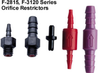
from Air Logic
The Orifice Restrictors are designed for use in pneumatic control circuits and are available in eleven color coded sizes. They are precision molded of polysulfone and are held to flow tolerances of ± 4%. The F-2815 Series are for inline installation with straight ports for 1/16" I.D. fleible... [See More]
- Applications: Medical; Pneumatic Control; Instrumentation & Industrial
- Max Pressure: 100
- Orifice Diameter: 0.0040
- Flow Tolerance: 4

from Air Logic
The Preset Flow Control maintains a constant flow in one direction and full flow in the opposite direction. The operation of the Flow Control is based on the movement of a small disc. The disc shifts within the housing as the pressure differential changes from forward to reverse. An orifice... [See More]
- Applications: Medical; Pneumatic Control; Instrumentation & Industrial
- Max Pressure: 75
- Orifice Diameter: 0.0040
- Media Temperature: 40 to 120