
English Straight Thread Male Flow Orifices and Flow Restrictors
Description
English Straight Thread Male Flow Orifices and Flow Restrictors are devices designed to control the flow rate of fluids through a system. They achieve this by providing a fixed restriction within the flow path, which limits the amount of fluid that can pass through at any given time. These devices are typically used in systems where precise flow control is necessary.
Working Principle
The working principle of flow orifices and flow restrictors involves creating a pressure drop across the device, which in turn reduces the flow rate of the fluid. This is achieved by having a specific size and shape of the orifice or restriction that the fluid must pass through. The pressure drop is a function of the fluid's velocity, density, and viscosity, as well as the size of the orifice. These devices are useful because they provide a simple and reliable means of controlling flow rates without the need for complex control systems.
Applications
Flow orifices and flow restrictors are used in a variety of applications. For example, in water jet applications, they convert energy from pressure to velocity, producing an outgoing stream of water traveling at high speeds. They are also used in atmospheric burners to ensure the correct gas flow and sufficient velocity and suction. Additionally, snubbers, a type of flow restrictor, are used in pressure or process lines to provide shock absorption or dampening.
Advantages over other Flow Orifices and Flow Restrictors
One advantage of English Straight Thread Male Flow Orifices and Flow Restrictors is their compatibility with various connection standards, such as unified national course (UNC) and unified national fine (UNF) threads, which can simplify integration into existing systems. They are also available in a range of materials, including metals and thermoplastics, allowing for selection based on specific environmental and operational requirements.
Limitations
A limitation of these devices is that they rely on a constant pressure, temperature, and viscosity to maintain a consistent flow rate. Variations in these parameters can lead to changes in flow rate, which may not be acceptable in all applications. Additionally, the fixed nature of the restriction means that they are not suitable for applications requiring variable flow rates.
Considerations
When selecting flow orifices and flow restrictors, it is important to consider factors such as initial costs, operating expenses, durability, and maintenance requirements. Devices made from durable materials like brass or aluminum may offer longer service life and lower maintenance costs. However, the initial cost may be higher compared to devices made from less durable materials. Additionally, the accuracy of flow control and the ease of replacement should be considered, especially in systems where precise flow regulation is critical.
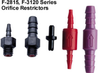
from Air Logic
The Orifice Restrictors are designed for use in pneumatic control circuits and are available in eleven color coded sizes. They are precision molded of polysulfone and are held to flow tolerances of ± 4%. The F-2815 Series are for inline installation with straight ports for 1/16" I.D. fleible... [See More]
- Connection: Male English Straight Thread; Barbed or Ribbed End
- Max Pressure: 100
- Orifice Diameter: 0.0040
- Flow Tolerance: 4

from Air Logic
The Preset Flow Control maintains a constant flow in one direction and full flow in the opposite direction. The operation of the Flow Control is based on the movement of a small disc. The disc shifts within the housing as the pressure differential changes from forward to reverse. An orifice... [See More]
- Connection: Male English Straight Thread; Female English Straight Thread; Barbed or Ribbed End
- Max Pressure: 75
- Orifice Diameter: 0.0040
- Media Temperature: 40 to 120