
Graphic Results Motor Test Equipment
Last Updated: February 12, 2025
Description
Graphic Results Motor Test Equipment is designed to evaluate the electrical health of motor components. It provides a comprehensive assessment of motor conditions by analyzing various parameters such as impedance, inductance, phase angle, and current frequency. This equipment is capable of generating a 'machine health' value through a quick, three-phase test, which helps in identifying potential issues in motors.
Working Principle
The working principle of Graphic Results Motor Test Equipment involves the use of patented technologies to assess motor health. It utilizes a proprietary algorithm to analyze the electrical characteristics of motor components. By evaluating impedance, inductance, phase angle, and current frequency, the equipment can determine the condition of induction windings, rotors, and associated connections. This process is crucial for ensuring the reliability and efficiency of motors, as it helps in early detection of faults and reduces downtime.
Applications
Motor test equipment is widely used in various applications, including repair, maintenance, design verification, and failure analysis of electrical motors. It plays a significant role in improving the efficiency and lifespan of motors by managing and monitoring equipment processes in production environments. Specific examples include testing new and repaired motors prior to acceptance and ensuring the safety and dependability of motors in industrial settings.
Advantages over other Motor Test Equipment
One of the key advantages of Graphic Results Motor Test Equipment is its ability to provide a complete motor health assessment in a single test. The use of patented dynamic stator and rotor signatures allows for a thorough evaluation of motor components, making it ideal for testing both new and repaired motors. Additionally, the equipment's ability to automatically sequence test steps and make decisions regarding motor acceptability enhances its efficiency and accuracy compared to other motor test equipment.
Limitations
While Graphic Results Motor Test Equipment offers numerous advantages, it may have limitations in terms of its initial cost and complexity of operation. The proprietary technologies and algorithms used in the equipment might require specialized training for operators, which could be a barrier for some users.
Considerations
When considering the use of Graphic Results Motor Test Equipment, it is important to evaluate factors such as initial costs, operating expenses, and maintenance requirements. The equipment's durability and accuracy are critical for ensuring long-term reliability and performance. Additionally, potential users should consider the costs associated with replacement parts and regular maintenance to ensure optimal functionality.
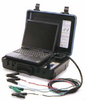
from PdMA Corporation
The MCE ™ (Motor Circuit Evaluator) is a comprehensive static motor tester that produces detailed analyses of motor and circuit conditions in as little as three minutes. Analysis of the motor and associated circuits through MCE ™ testing allows for the detection of electrical faults in... [See More]
- Features: Battery Powered; Computer Interface; Storage; Integrated Data Logger; Graphic Results; Printer / Plotter Interface
- Offline Test Parameters: Dielectric Absorption Ratio; Field Capacitance; Field Ground Resistance; Field Inductance; Field Resistance; Ground Capacitance; Inductance Balance; Resistance Balance; Phase to Phase Resistance; Phase to Phase Inductance; Polarization Index
- Form Factor: Mobile
- Input Voltage: 250 to 5000

from PdMA Corporation
MCEMAX ™ powered by MCEGold ® integrates testing, diagnostics, inventory control, scheduling, and cost containment. The comprehensive tester monitors all potential fault zones and allows for immediate notification of alarming conditions. The unique static and dynamic operation enables... [See More]
- Features: Battery Powered; Computer Interface; Storage; Integrated Data Logger; Graphic Results; Printer / Plotter Interface
- Offline Test Parameters: Dielectric Absorption Ratio; Field Capacitance; Field Ground Resistance; Field Inductance; Field Resistance; Ground Capacitance; Inductance Balance; Resistance Balance; Phase to Phase Resistance; Phase to Phase Inductance; Polarization Index
- Form Factor: Mobile
- Input Voltage: 250 to 5000

from PdMA Corporation
The EMAX tester allows for proactive predictive maintenance without requiring a shutdown of the motors for access. The power and convenience of dynamic testing collects data without interrupting production processes. The EMAX can be used for process analysis with motor current signature analysis and... [See More]
- Features: Battery Powered; Computer Interface; Storage; Integrated Data Logger; Graphic Results
- Online Test Parameters: Average Current; Crest Factor; Efficiency; Full Load Amps; Impedance Imbalance; Inrush/Startup Current; Line to Neutral Voltage; Output Power; Phase Current; Phase Impedance; Phase to Phase Voltage; Power; Power Factor; Current Spectral Analysis; Total Harmonic Distortion; Torque; Voltage Imbalance
- Form Factor: Mobile
- Input Voltage: 0.0 to 600