
40-20 Scratch / Dig Ball Lenses
Description
40-20 Scratch / Dig Ball Lenses are optical components characterized by their spherical shape and specific surface quality rating. The "40-20" designation refers to the surface quality, indicating the maximum allowable scratch width of 0.04 mm and a dig diameter of 0.20 mm. These lenses are designed to manage light transmission and are typically used in applications requiring precise optical performance.
Working Principle
Ball lenses work by focusing or collimating light through their spherical geometry. The spherical shape allows for uniform light distribution and minimal optical distortion, making them effective for coupling light into optical fibers or other optical systems. The 40-20 scratch/dig specification ensures a certain level of surface smoothness, which is crucial for minimizing light scatter and maintaining optical clarity. This makes them particularly useful in applications where precise light control is necessary.
Applications
40-20 Scratch / Dig Ball Lenses are commonly used in fiber optic communication systems, where they facilitate efficient light coupling between fibers or between a laser and a fiber. They are also employed in barcode scanning devices, sensors, and other miniature optical systems where space is limited, and precise light manipulation is required.
Advantages over other Ball Lenses
One of the advantages of 40-20 Scratch / Dig Ball Lenses is their balance between cost and performance. They offer a good level of surface quality that reduces light scatter without the higher costs associated with more precise lenses like the 20-10 or 10-5 specifications. This makes them suitable for applications where high precision is needed but budget constraints are a consideration.
Limitations
The primary limitation of 40-20 Scratch / Dig Ball Lenses is their surface quality, which may not be sufficient for high-precision laser applications that require minimal surface imperfections. In such cases, lenses with a higher surface quality rating, such as 20-10, may be necessary to prevent laser-induced damage.
Considerations
When selecting 40-20 Scratch / Dig Ball Lenses, consider the initial cost, which is generally lower than lenses with higher surface quality ratings. Operating expenses are typically minimal, but durability and accuracy can be affected by the surface quality, especially in demanding environments. Replacement and maintenance costs are also relatively low, but regular inspection is recommended to ensure the lenses maintain their optical performance over time.
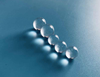
from Changchun Yutai Optics Co., Ltd.
BK7 balls are precision machined from high quality optical glass material (BK7), which is highly sought after for its excellent optical properties and wide range of applications.BK7 glass is commonly used in the design of optical systems because of its high transmission and low dispersion in the... [See More]
- Surface Quality: 40-20 Scratch / Dig
- Lens Features: Antireflection Coating
- Materials: BK7 Glass
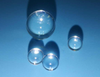
from Changchun Yutai Optics Co., Ltd.
Sapphire balls are precision machined and polished with a high surface quality to minimize light scattering and reflection, ensuring the imaging quality and transmission efficiency of the optical system, providing you with reliable optical performance and long-lasting durability. What are the... [See More]
- Surface Quality: 40-20 Scratch / Dig
- Materials: Sapphire
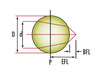
from Changchun Yutai Optics Co., Ltd.
Fused silica balls are high performance optics for scenarios where ultraviolet, high temperatures, chemical corrosion, high power lasers, low thermal expansion and high transmittance are required. Selection requires a trade-off between performance and cost based on specific needs. What are the... [See More]
- Surface Quality: 40-20 Scratch / Dig
- Materials: BK7 Glass; Ultra-violet grade Fused Silica
- Lens Application: Ultraviolet
from Knight Optical (UK) Ltd
Ball lenses are, as the name suggests, completely spherical lenses most commonly used to couple light in and out of fibres. Knight Optical supplies a range of stock ball lenses as well as bespoke designs to your own specifications. Our stock ball lenses offered in quartz have excellent UV and IR... [See More]
- Surface Quality: 40-20 Scratch / Dig
- Diameter / Length: 0.0025
- Focal Length: 1.1
- Materials: BK7 Glass

from Artifex Engineering
Most useful when coating is not an issue. Very tight diameter tolerance for accurate fibre coupling. [See More]
- Surface Quality: 40-20 Scratch / Dig
- Materials: BK7 Glass
- Diameter / Length: 10

from Tower Optical Corporation
Ball lenses are used for various tasks such as improving the coupling between optical fibers and the emitters or detectors they interface with. Standard size lenses range from 1.0mm to 5.0mm. Custom made sizes or special materials are also available. All Ball lenses can be ordered with full-surface... [See More]
- Surface Quality: 40-20 Scratch / Dig
- Materials: BK7 Glass (optional feature); Ultra-violet grade Fused Silica (optional feature)
- Diameter / Length: 1 to 10
- Lens Features: Antireflection Coating (optional feature)

from Changchun Sunday Optics Co., Ltd.
With the roof surface, these prisms are used to invert and reverse the image.A roof prism may be used to revert and invert the image as well as bend the line of sight through a 90 degree angle, We provide roof right angle prisms, roof penta or half penta prisms, Schmidt prisms, or other roof prism... [See More]
- Surface Quality: 40-20 Scratch / Dig
- Materials: Ruby
- Diameter / Length: 0.3000 to 50
- Lens Features: Antireflection Coating

from Changchun Sunday Optics Co., Ltd.
CPV Solar Power Prisms is used to collect the sunlight, for solar condenser, solar energy concentrating photovoltaic (CPV) system, solar power generation, etc., which is the main optical component when solar power transform to electric energy. [See More]
- Surface Quality: 40-20 Scratch / Dig
- Materials: Sapphire; Sapphire
- Diameter / Length: 0.3000 to 50
- Lens Features: Antireflection Coating

from Changchun Sunday Optics Co., Ltd.
Wedge prism has plane inclined surfaces. It deflects light toward its thicker portion. It can be used individually to deflect a beam to a special angle. Two wedge prisms work together can assembly an anamorphic prism to correct the elliptical shape of laser beam. The wedge prism is ideal for laser... [See More]
- Surface Quality: 40-20 Scratch / Dig
- Materials: ZnSe
- Diameter / Length: 0.3000 to 50
- Lens Features: Antireflection Coating

from Changchun Sunday Optics Co., Ltd.
A ritalic prism can produce a lateral displacement of light, but does not change its direction of propagation. Rhombic prism is widely used in stereoscopic microscope, periscope and other instruments [See More]
- Surface Quality: 40-20 Scratch / Dig
- Materials: Ruby
- Diameter / Length: 0.3000 to 200
- Lens Features: Antireflection Coating

from Changchun Sunday Optics Co., Ltd.
Right angle prisms are used to deflect a light beam with 90 or 180 °. Prisms are widly used in optical system, which can reflect, deviate and rotate beams of light as well as dispersing their wavelengths.Right angle prisms are usually coated with Reflective coating when used.It has a larger... [See More]
- Surface Quality: 40-20 Scratch / Dig
- Diameter / Length: 0.3000 to 200
- Lens Application: Infrared; Visible
- Materials: Ruby