
Dimensional and Profile Scanners Information
Dimensional and profile scanners gather two-dimensional (2D) or three-dimensional (3D) information about an object. They incorporate a wide range of scanning technologies and form factors.
Two- and three-dimensional scanning acts as a bridge between a product and the manufacturing process. Conversion of a physical entity into computer-aided engineering (CAE) data allows for streamlined part analysis, precise dimensional measurement, and other design functions. Typical scanning tasks include basic dimensional measurement, two- or three-dimensional profiling, determining object orientation, depth mapping, digitizing, and shaft measurement.
Manufacturing control is an important dimensional scanning application. By routinely scanning manufactured parts, engineers can easily determine out-of-tolerance conditions and make adjustments to improve future quality. Other applications and industries include:

-
Reverse engineering
-
Inspection and analysis
-
Product testing
-
Part damage assessment
-
Part design archiving, to replace lost or outdated parts
Types and Technologies
There are numerous methods and scanner types for dimensional scanning of a physical object. These types are discussed in detail below.
Laser Scanning
Laser scanning is a common method for 3D profiling. It is referred to as an active method, as laser scanners emit radiation rather than simply detect it. Laser scanning uses one or more techniques, including laser triangulation, time of flight, and phase shifting, to provide 3D measurements of a part. These methods are described in the list below.
Laser triangulation involves projecting a line, point, or (more frequently) a stripe, which is reflected by the object and captured by a sensor which is a fixed distance from the laser emitter. The sensor detects the reflection angle, which is used to calculate 3D measurements. Scanners which use laser triangulation are typically portable and easy to use but less accurate than other types.
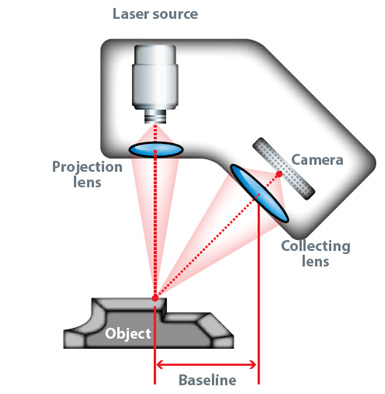
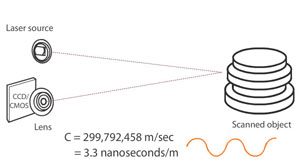
Laser triangulation (left) and phase shift scanning. Image credits: Innovmetric | 3D Systems
White Light Scanning
White light scanners project a known pattern of light and use sensors to detect and capture images of the object with the light patterns projected onto it. They may use either multiple patterns or multiple sensors to gather 3D information. White light scanners are fast and precise, as they are able to scan an entire field of view rather than single points. Like laser scanning, white light scanning is an active method.
Demonstrating a white light 3D scanner. Video credit: 3d3solutions / CC BY-SA 4.0
Photogrammetry and Videogrammetry
Photogrammetry and videogrammetry use still and video cameras, respectively, to digitize objects. They are both referred to as passive scanning methods, as they detect visible light but do not emit radiation. In the case of photographic imaging, scanners take multiple images of an object and reconstruct them by referencing certain points common to each photograph. Photogrammetry is often used in conjunction with other 3D scanning techniques to provide full surface measurements and improve tolerances over large areas.
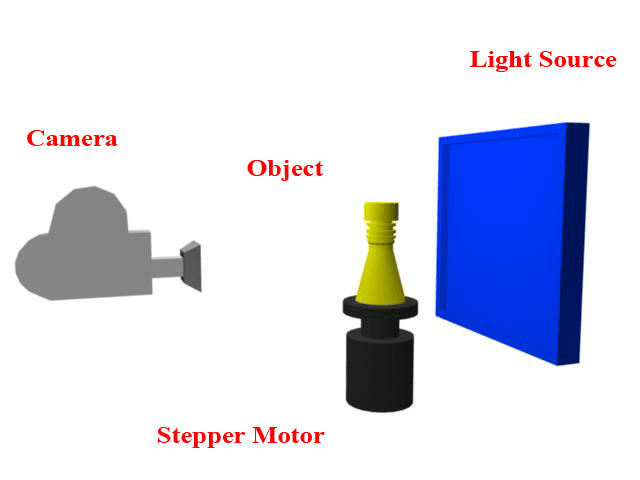
These two imaging techniques may be employed in the scanner systems below.
Stereoscopic scanners employ two video cameras which view an object from slightly different perspectives. Distance to each image point can be determined by analyzing the subtle differences between the camera images.
Coordinate Measuring Machines
Coordinate measuring machines (CMM) are contact scanners which use movable probes to measure an object. Each machine axis is equipped with encoders that track the movement of the probe. They are typically large, fixed devices but are also available in portable form, albeit with reduced accuracy. CMMs are capable of significant precision but have several inherent disadvantages, including the need for direct contact and slow speeds.

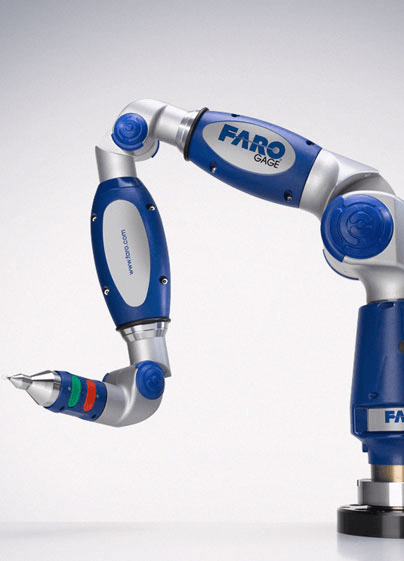
A fixed CMM (left) and a portable device. Image credits: Inspec Inc. | Q-PLUS Labs
Form Factor and Control
Size and form factor are important specifications to consider when selecting a dimensional scanner. Most scanners are designed to measure and digitize a relatively small, discrete part, and as such are semi-permanent benchtop or free-standing machines. However, some photogrammetric and videogrammetric scanners are handheld in order to scan and measure much larger objects such as buildings. An example of a portable handheld scanner is shown at the top of this page.
Scanners may be manually controlled, which is typically the case in portable and handheld devices, or automatically controlled using computer numerical control (CNC) or a personal computer (PC). A CNC machine-mounted scanner can be combined with a CAD system and additional tooling heads to provide an integrated manufacturing solution, as shown in the video below.
A CNC scanning/cutting operation. Video credit: Scantech Denmark / CC BY-SA 4.0
Standards
The standards below pertain to dimensional and profile scanners. These published documents may govern the production, testing, and use of products.
-
ISO 10360 Acceptance and reverification tests for coordinate measuring machines (CMM)
-
ASME B89.4.22 Performance evaluation methods for articulated coordinate measuring machines
References
3D Scan Co - 3D Scanning
3D Systems - A guide to 3D scanners
Image credits:
- 2-D Scanning / Profiling
- 3-D Scanning / Profiling
- Angularity / Orientation
- Benchtop
- CNC
- Coordinate Measuring Machine (CMM)
- Crash Protection
- Depth Mapping
- Digitizing / Imaging
- Dimensional Measurement
- Free Standing
- Handheld
- Laser Triangulation
- Manual
- Offline Programming
- PC
- Portable
- Profile Measurement
- Reverse Engineering
- Shaft Measurement
- Shop Floor Suitable
- Touch Probe (Discrete Point)
- Video Camera