
Rubber and Elastomer Molding Services Information
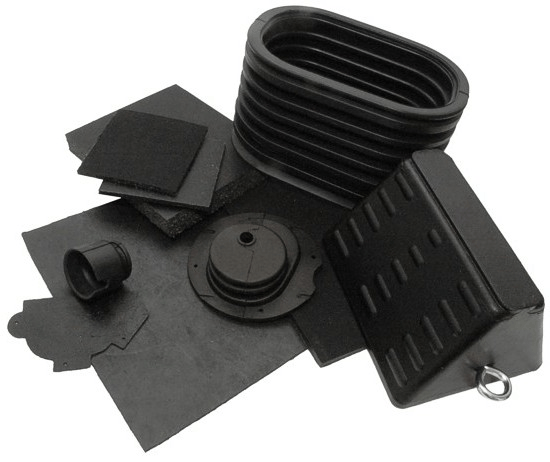
Rubber molding service providers use a variety of methods and materials to manufacture rubber products such as seals, grips, and caps. Most production methods pour liquid rubber into a heated, cooled, expandable, or two-part mold. Temperature, air, or pressure then forms the material into a finished product. Typically, application requirements such as resistance and temperature determine which material is used.
Manufacturing Processes
Rubber molding services use a variety of manufacturing processes. Each manufacturing practice has advantages and disadvantages or may be used for a particular material.
| Process | Pros | Cons |
| Blow Molding |
|
|
| Cast Urethane | High Performance Physical Properties | Material Specific Molding Process |
| Compression Molding | Economical Mold Design; Minimal Material Waste | Process Time; Low Volume Production; Excess Flash |
| Dip Molding | Low Tooling Cost; Low and High Volume Production | Process Time; Precision Control; Geometry Dependent |
| Injection Molding | High Productivity; Low Unit Cost | Expensive Tooling; Use of Low Molecular Weight Polymers |
| Liquid Injection Molding (LIM) | High Volume; Low Unit Cost; Fast Cure Cycle | Expensive Tooling; Size and Shape Limitations |
| Transfer Molding | Ideal for Molding w/ Metal Inserts; Product Consistency | Moderate Tooling Cost; Use of Pre-Measured Molding Compound |
Blow Molding
Blow molding is a process commonly used when parts are hollow in design. Elastomer materials are injected into a hollow molten tube or "parison." The mold encapsulates the parison while compressed air blows up the parison like a balloon, forcing it outward to conform to the inside shape of the mold. After cooling, a hollow part emerges. The injection phase may be used to form a neck or thread diameter with fine tolerances. Double-wall blow molding combines two hollow blow-molded parts to form a strong, light-weight end product. One disadvantage of blow molding is that it is limited by blow ratios. The blow ratio is calculated as:
Blow Ratio = H/W = max depth of cavity/smallest dimension of cavity opening
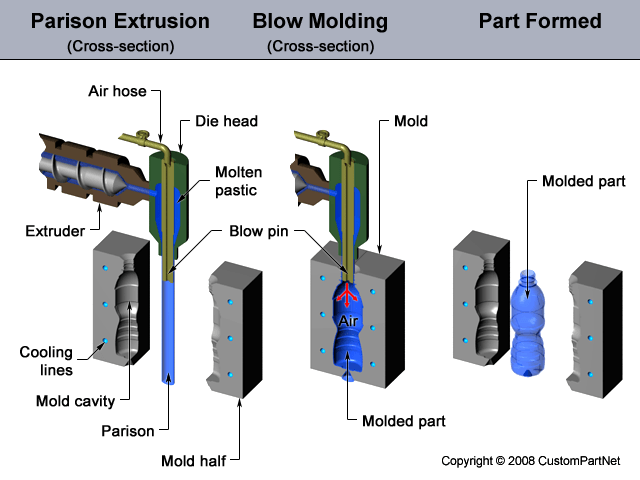
Image Credit: CustomPartNet
Compression Molding
In compression molding, slugs of rubber are pressed between two heated mold halves and the finished part is then air-cooled. The slugs are sized and weighed for the mold cavity. The solid material is clamped and cured before a finished piece is ejected.
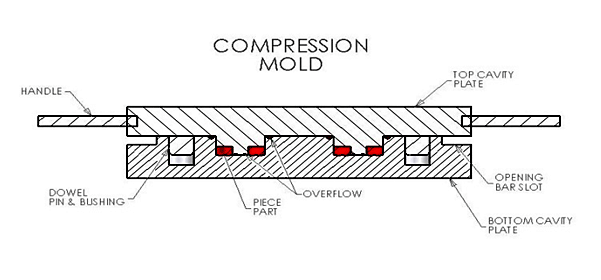
Image Credit: Flexan Corporation
Cast Urethane
In cast urethane molding, open molds are filled with liquid urethane, an elastomer that provides excellent wear resistance, high tensile strength and high elasticity.
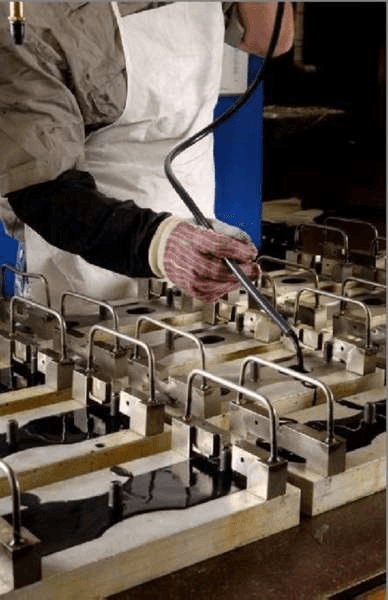
Image Credit: All-State Industries, Inc.
Dip Molding
Dip molding is used to produce such parts as gloves, grips, and protective caps. The process is similar to hot dip coating, in which the finished product is the fused elastomer or rubber material stripped from the dipped mold. Thickness and precision of the finished product is dependent on temperature of the mold, temperature of the resin, speed of dip (in and out), and bath time.
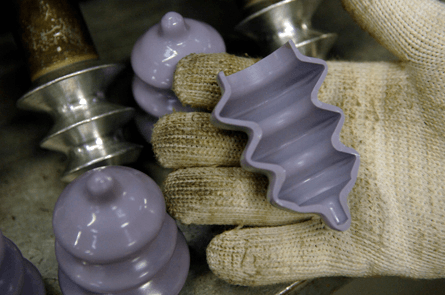
Image Credit: Materials & Matter for Curious Designers
Injection Molding
Injection molding, also known as rubber injection molding, forces liquid rubber into a cooled mold. When the material solidifies, the mold is unclamped and the finished part is ejected. Multiple plates are used and clamped together in order to segregate the mold cavity from the runner and injection ports. The liquid rubber flows into a runner in the first plate that feeds the mold cavity through one or several sprues. The runner and sprues help control an even and consistent flow of rubber or elastomer material into the mold cavity.
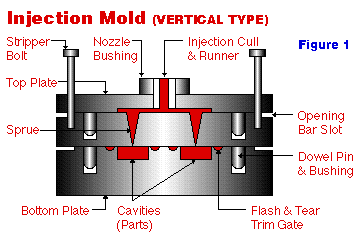
Image Credit: The Rubber Group
Liquid Injection Molding (LIM)
Liquid injection molding (LIM) is a suitable process for high volume production of silicone and fluorosilicone products and materials. The process is a closed system that involves injection of a dual component mixture, a catalyst and crosslinker, into a heated and pressurized mold. The two part mixture has a low viscosity, allowing for smaller runner and sprue volumes. Thermosetting takes place during a short time span and the end result is a high quality product.
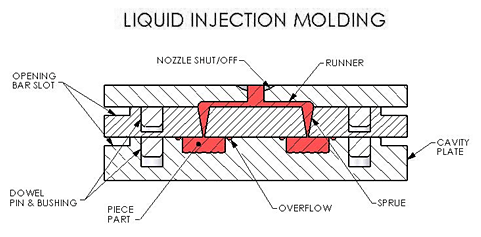
Image Credit: Flexan Corporation
Transfer Molding
In transfer molding, the two mold halves are clamped together and the rubber or silicone is forced by pressure into a heated mold. A slug is placed in a chamber (called a pot), usually at the top of the mold. The assembly is placed in a press that applies pressure to the open end of the pot via a piston-like tool head. The press forces the rubber to flow through one or more spruces into the heated mold. The mold cavity is then cured for a set time before ejecting the finished part.
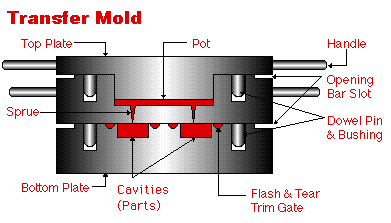
Image Credit:Hawthorne Rubber Mfg. Corp.
Material Selection
Elastomers and rubber materials are natural or synthetic polymers with a high degree of flexibility and viscoelasticity (elasticity). Elastomers are usually thermosets that require vulcanization, but also include various thermoplastics. Application requirements determine which natural and synthetic materials rubber molding services use.
Natural rubber materials include:
Polyisoprene, also known as gum rubber, is a common organic compound with the formula CH2=C(CH3)CH=CH2. It is a mixture of latex and other organic compounds and is commonly used as the building block for many synthetic rubber and elastomer material.
Latex is a colloidal sap produced by the Para rubber tree. Latex is often used in the medical industry, or for protection against liquids and other chemicals. Garments made of Latex are often disposable.
Synthetic rubber materials include:
Neoprene is a flexible, twistable compound that provides better burn resistance than natural materials.
Nitrile and styrene butadiene rubber (SBR) provide good resistance to a variety of petroleum hydrocarbons.
EPDM is used to withstand damage from sunlight, weathering, and ozone, but does not possess good resistance to hydrocarbons.
Butyl, an isobutylene isoprene elastomer, is valued for its resistance to water, steam, alkalis, and oxygenated solvents.
Silicone, a synthetic material available in both solid and liquid forms, is durable and free of allergens or leachable chemicals.
Fluoroelastomers are similar to silicone in mechanical and physical properties, but offer improved resistance to fuel and mineral oil. Highly fluorinated, carbon backboned polymers resist harsh chemicals and provide good thermal stability.
The following table includes typical performance properties of common rubber and elastomer materials:
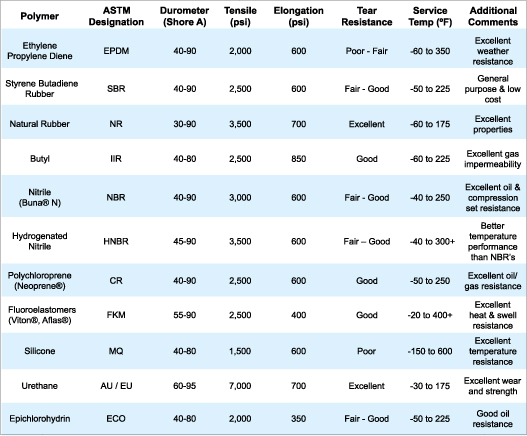
Image Credit: Molded Products, Inc.
Resources:
Determining the Right Molding Process for Part Design
Introduction to Dip Molding and Coating
Rubber Molding Design Guidelines and Review
Image Credit: KN Rubber
- Alabama
- Arkansas
- Arizona
- California
- Colorado
- Connecticut
- Florida
- Georgia
- Iowa
- Illinois
- Indiana
- Kansas
- Kentucky
- Louisiana
- Massachusetts
- Maryland
- Maine
- Michigan
- Minnesota
- Missouri
- Montana
- North Carolina
- Nebraska
- New Hampshire
- New Jersey
- Nevada
- New York
- Ohio
- Oklahoma
- Oregon
- Pennsylvania
- Rhode Island
- South Carolina
- Tennessee
- Texas
- Virginia
- Washington
- Wisconsin
- AFLASTM
- Assembly Services
- Blow Molding
- Bonding
- Butyl
- Canada Only
- Cast Urethane
- Clean Room Molding
- Compression Molding
- Design Assistance
- Dip Molding
- EPDM
- East Asia / Pacific Only
- Europe Only
- Fluoroelastomer (FKM - Viton®, Fluorel®, etc.)
- Fluorosilicone (FVMQ, FMQ, FPM, FSI)
- Graphics
- High Volume Production (Long Runs)
- Injection Molding
- Insert Molding
- Just-In-Time Capability
- Large Part Molding
- Liquid Injection Molding (LIM)
- Low Volume Production (Short Runs)
- Machining
- Micro Molding
- Midwest US Only
- Natural Rubber
- Near East Only
- Neoprene
- Nitrile (NBR, XNBR, HNBR)
- North America
- Northeast US Only
- Northwest US Only
- Packaging / Shipping
- Polyurethane / Urethane
- Prototype / Market Entry Molding
- Silicone / Liquid Silicone
- South Asia Only
- Southern US Only
- Southwest US Only
- Styrene Butadiene Rubber (SBR)
- TPE / TPR
- Tool / Mold Making
- Transfer Molding
- United States Only