
Capacitive Linear Position Sensors Information
Capacitive linear position sensors measure position, displacement, vibration, and run out (thickness), primarily in a noncontact manner. They have good accuracy and very high resolution, but may be sensitive to environmental factors.
Noncontact capacitive sensors measure changes in capacitance. Capacitance describes how two objects with a space between them respond to a voltage difference applied to them. This video illustrates:
Video Credit: Pebble Soup / CC BY 3.0
Types of Capacitive Linear Position Sensors
One type of capacitive sensor features conductive probe and target objects.
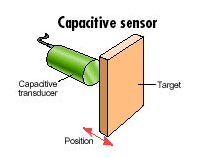
Image Credit: Machine Design.com
For nonconductive targets, a stationary target plate may be used. When the nonconductor is placed between the probe and the target, the thickness, density, and/or position of the material changes the dielectric constant of the interval space.
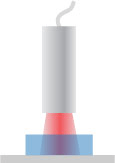
Image Credit: Lion Precision
In cases of nonconductive sensing without a reference, the sensing electric field wraps back to the probe, creating a "fringe field." When a nonconductive material nears the probe, its ectric changes the field.

Image Credit: Lion Precision
Specifications and Features
- Measurement ranges vary (e.g. 0.004 to 0.35 inches).
- Sensing frequency varies (e.g. 0.42 to 26 kHz).
- Electrical output signals can be analog (current, voltage, or frequency), digital (serial, parallel, or other), an alarm, or a change in state of switches.
- Packaging varies from none (a sensor element) to housed (transducer). Instruments or meters are self-contained and display output at or near the device. A gauge or indicator has an analog display and no electronic output.
- Devices can tolerate maximum shocks, maximum vibrations, and certain temperature ranges (e.g. -100 to 1832°F).
- Recorders and totalizerscan be added to collect and store data locally.
Applications
Capacitive sensors measure position (automation, semiconductor processing, disk drives), dynamic motion (tool spindles, disk drive spindles, high-speed drill spindles, ultrasonic welders), and thickness (silicon wafer, brake rotor, disk drive platter, label positioning). They also can perform assembly testing.
References
Capacitive Sensors-An Overview
Capacitive Sensors (pdf)