The size (spatial coherence) and monochromaticity (temporal coherence) of the light
source must satisfy certain minimum requirements that depend on the geometry of
the system, as described by Hansen (1955, 1984) and by Birch (1979). It is interesting
to know that if the optical element under test has very steep reflections, the state of
polarization of the light may change in the reflection, introducing changes in the
contrast (Ferguson, 1982). However, in most of the cases, the important factor in the
contrast is the coherence of the light source.
2.3.1. Spatial Coherence
The light source for interferometry must satisfy some minimum requirements of
spatial as well as temporal coherence, depending on the interferometer configuration
and the specific application and needs. As described in Chapter 1, Section 1.1.2.,
some gas or vapor lamps can be used in conjunction with a small pinhole to
illuminate an interferometer. These lamps with the pinhole do not have perfect
spatial and temporal coherence. A gas laser, however, has perfect spatial coherence
and can have almost perfect temporal coherence. We might think at first that this is
the ideal light source for interferometry, but this is not always the case. The
coherence length is, in general, so large that many unwanted reflections from other
surfaces in the optical system may produce a lot of spurious fringes in addition to the
speckle noise that make it difficult to analyze the interferogram. On the contrary, the
perfect spatial coherence produce scattering spherical waves from many unavoidable
small pieces of dust or scratches on the optical elements, which in turn produce many
spurious rings of fringes. This problem has been studied in detail by Schwider (1999).
The conclusion is that, quite frequently, it is a better option to use a gas or vapor
light source instead of a laser. However, if the optical path difference is large, it is
unavoidable to use a gas laser. In this section we will study the coherence requirements
for the light source.
There are two cases for which the collimated wavefront has ray lights spread over
a solid angle with diameter 2θ, and hence the final accuracy of the interferometry or
the contrast will be reduced:
(1) The collimator has spherical aberration, in which
where TA is the maximum value of the transverse spherical aberration of the
collimator at its best focus position. This aberration might limit the accuracy of
the interferometer unless the OPD remains constant with changes in the angle θ.
Otherwise, given the maximum value of θ, the maximum change in the OPD should
be smaller than the desired accuracy.
(2) The light source is not a mathematical point but has a small diameter 2a; then
| |  |
where f is the focal length of the collimator.
Fringes with high contrast are obtained, using an extended thermal source, only if
the OPDs for the two paths from any point of the source with different value of θ
differ by an amount smaller than λ/4 according to the Rayleigh criterion. On the
contrary, radiometric considerations usually require as large a source as possible that
will not degrade the contrast of the fringes.
When the beam splitter is a glass plate and is not compensated by another identical
glass plate, we may show that the maximum light source size has an elliptical shape.
This is the reason why the fringes are elliptical in an uncompensated Michelson
interferometer. The shape and the size of the ellipse not only are functions of φ0, θ,
and ψ but also depend very critically on t0.
The simpler case of a glass plate with its normal along the optical axis can be
analyzed with more detail as will be shown. The OPD is given by Eq. (2.7). As shown

in Figure 2.12, the value of the OPD changes with the value of θ depending on the
value of t0. The maximum allowed value of the angular semidiameter θ of the light
source as seen from the collimator is that which gives a variation of the OPD equal to
λ/4. On the contrary, the maximum allowed value of the angle θ due to spherical
aberration of the collimator is that which gives a variation of the OPD equal to the
accuracy desired from the interferometer.
When testing small optics using a nonmonochromatic light source, the optical
path difference can be adjusted to be zero. Then, it is convenient to choose
so that OPD(0o) = 0, but this situation will require an even smaller light source. It
should be pointed out that when testing large optics, the value of t0 cannot be changed
at will, because in general it will be very large.
If an extended quasi-monochromatic light is used, a good condition in order to
make the optical path difference insensitive to the angle θ is
yielding
| |  |
It is interesting to see that this equation is equivalent to the condition that the
apparent distance of the image of the collimator (or the light source in a Michelson
interferometer) to the observer is the same for both arms of the interferometer. This
condition seems reasonable if we consider that then the angular size of the two
images of the light source is the same as pointed out by Steel (1962) and Slevogt
(1954).
When the light source is extended and the interferometer is compensated in this
manner, the fringes are localized at a certain plane in space. To find this plane, the
system may be unfolded as studied by Hansen (1942, 1955). For an interferometer
with plane mirrors, this location for the fringes is near the plane mirrors because of
the way the image of the light source moves when one of the mirrors is tilted in order
to obtain the fringes as shown in Figure 2.5. Thus, the viewing system must be
focused near the mirrors to see the fringes.
As it will be described later in this chapter, to test an optical system, one of the
plane mirrors is replaced by the system to be tested, plus some auxiliary optics to
send back a collimated beam to the interferometer, just like one single mirror would
do. The returning collimated beam has to have the same diameter. Thus, it is easy to
conclude that this whole system, including the element under test has the following
general characteristics:
- It is afocal.
- Its magnification is either one or minus one. If it is minus one, the returning
wavefront will be rotated with respect to the incident wavefront. - The system is symmetric and hence it is always free of coma.
- Entrance and the exit pupil are symmetrically placed with respect to the
system and have the same diameter.
With these properties we see that since the system is reflective (it is retroreflector
only if the magnification is minus one), the entrance and exit pupil are at the same
plane. An important conclusion is that the fringes should be observed at this entrance
and exit pupil plane. This problem has been studied with detail by Schwider and
Falkenstorfer (1995).
It should be noticed that the entrance pupil of the whole system is not necessarily
the same as the pupil of the lens under test. However, when testing a lens, the fringes
are to be observed at the pupil, which ideally should be the same. This does not
happen with a single mirror; therefore, the mirror should be as close as possible to the
lens. This is the reason why a convex mirror with the longest possible radius of
curvature is desirable (Steel, 1966) when testing telescope objectives. On the contrary,
the entrance pupil of a microscope objective is at infinity; hence, the exit pupil
is at the back focus. Dyson (1959) described an optical system such as the one to be
described in Chapter 12, which images the mirror surface on the back focus of the
microscope objective, where the fringes are desired.
The limitation on the size of a pinhole source was examined in a slightly different
manner by Guild (1920–1921) as explained below. Imagine that the small source is
greatly enlarged to form an extended source. Then fit an eyepiece in front of lens L2
(see Fig. 2.1) to form a telescope. Under these conditions, equal inclination fringes in
the form of concentric rings (like the ones normally observed in the Michelson
interferometer) are observed. If the mirrors are exactly perpendicular to their optical
axes, the rings will be exactly centered. The ideal size of the source is that which
allows only the central spot on the fringe system to be observed. The size of
the central spot increases when the OPD (θ) reduces its dependence on θ by one
of the adjustments described above, making possible the use of a larger source,
although the effective size of the spot is then limited by the pupil of the observing eye
or the camera.
In all the foregoing considerations, the two interfering wavefronts are assumed to
have the same orientation, that is, without any rotations or reversals with respect to
each other. In other words, if one of the beams is rotated or reversed, the other should
also be rotated or reversed. A wavefront can be rotated 180o by means of a cube
corner prism or a cat’s-eye retroreflector formed by a convergent lens and a flat
mirror at its focus. The wavefront can be reversed upon reflection on a system of two
mutually perpendicular flat surfaces, e.g., in a Porro prism. Murty (1964) showed that
if one of the wavefronts is rotated or reversed with respect to the other, then, to have
fringes with good contrast and without phase shifts, the pinhole diameter 2α should
satisfy the condition
| |  |
so that diametrically opposite points over the wavefront are coherent to each other.
Here, f and D are the collimator’s focal length and diameter, respectively. Then 2α
is extremely small and therefore an impractical size for some sources. However,
there is no problem if a gas laser is used, because its radiance and spatial
coherence are extremely high. This subject will be examined with more detail
in Chapter 5.
When testing an optical element as it will be described in the following section,
the wavefront is sometimes inverted (up-down) or reversed (left-right) or rotated
(both), which is equivalent to a rotation of one of the wavefronts by 180o. Then, the
spatial coherence requirements increase. If a laser is used, no problem arises. If a gas
or vapor source is used, the reference wavefront has also to be inversed, reversed, or
rotated, like the wavefront under test.
When there is no alternative but to use a gas laser source, due to a large optical
path difference, speckle noise and spurious fringes may be reduced by artificially
reducing the spatial coherence of the light a little. This is possible by placing a small
rotating ground glass disc on the plane of the pinhole as described by Murty and
Malacara (1965), Schwider and Falkenstorfer (1995), and Schwider (1999).
© 2007

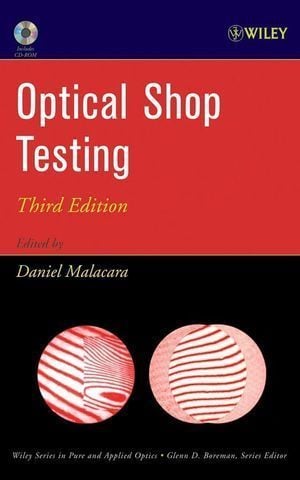 Since the publication of the second edition of this book, many important advances
have taken place in the field of optical testing. On one hand, the requirements for
faster and more precise tests are stronger than ever; on the other hand, the new
technological tools permit us to do these tasks much better than before. The need to
describe these advances in this book would lead us to a thicker and hence more
expensive book. This was not compatible with our desire to keep the price as low as
possible, and therefore several new things had to be done. One of them was to reduce
the description of some of the most mathematical sections in the book so as leaving
space for some more applied subjects. Another modification was to reduce as much
as possible the number of references at the end of each chapter, leaving only the most
relevant ones. To compensate it, a CD with the complete and almost exhaustive list of
references is included in the book. Another advantage of this is that the full list of
references is properly classified by topics or its possible applications. Since many
publications may have two, three or more subjects, it is included in each of these
sections. For example, a publication may describe a test that is useful for testing flats,
spheres, and prisms. In that case, this publication is present in all of these sections. A
reader with a particular optical tests need, may find some help by using this reference
list in PDF format. The list of publications in optical testing is so large that it is
impossible to expect that no important reference is missing. If so, the Editor
apologizes for overlooking any important reference. Of course the list may be
updated every one or two years.
Since the publication of the second edition of this book, many important advances
have taken place in the field of optical testing. On one hand, the requirements for
faster and more precise tests are stronger than ever; on the other hand, the new
technological tools permit us to do these tasks much better than before. The need to
describe these advances in this book would lead us to a thicker and hence more
expensive book. This was not compatible with our desire to keep the price as low as
possible, and therefore several new things had to be done. One of them was to reduce
the description of some of the most mathematical sections in the book so as leaving
space for some more applied subjects. Another modification was to reduce as much
as possible the number of references at the end of each chapter, leaving only the most
relevant ones. To compensate it, a CD with the complete and almost exhaustive list of
references is included in the book. Another advantage of this is that the full list of
references is properly classified by topics or its possible applications. Since many
publications may have two, three or more subjects, it is included in each of these
sections. For example, a publication may describe a test that is useful for testing flats,
spheres, and prisms. In that case, this publication is present in all of these sections. A
reader with a particular optical tests need, may find some help by using this reference
list in PDF format. The list of publications in optical testing is so large that it is
impossible to expect that no important reference is missing. If so, the Editor
apologizes for overlooking any important reference. Of course the list may be
updated every one or two years. TABLE OF CONTENTS