Preface
 Since the publication of the second edition of this book, many important advances
have taken place in the field of optical testing. On one hand, the requirements for
faster and more precise tests are stronger than ever; on the other hand, the new
technological tools permit us to do these tasks much better than before. The need to
describe these advances in this book would lead us to a thicker and hence more
expensive book. This was not compatible with our desire to keep the price as low as
possible, and therefore several new things had to be done. One of them was to reduce
the description of some of the most mathematical sections in the book so as leaving
space for some more applied subjects. Another modification was to reduce as much
as possible the number of references at the end of each chapter, leaving only the most
relevant ones. To compensate it, a CD with the complete and almost exhaustive list of
references is included in the book. Another advantage of this is that the full list of
references is properly classified by topics or its possible applications. Since many
publications may have two, three or more subjects, it is included in each of these
sections. For example, a publication may describe a test that is useful for testing flats,
spheres, and prisms. In that case, this publication is present in all of these sections. A
reader with a particular optical tests need, may find some help by using this reference
list in PDF format. The list of publications in optical testing is so large that it is
impossible to expect that no important reference is missing. If so, the Editor
apologizes for overlooking any important reference. Of course the list may be
updated every one or two years.
Since the publication of the second edition of this book, many important advances
have taken place in the field of optical testing. On one hand, the requirements for
faster and more precise tests are stronger than ever; on the other hand, the new
technological tools permit us to do these tasks much better than before. The need to
describe these advances in this book would lead us to a thicker and hence more
expensive book. This was not compatible with our desire to keep the price as low as
possible, and therefore several new things had to be done. One of them was to reduce
the description of some of the most mathematical sections in the book so as leaving
space for some more applied subjects. Another modification was to reduce as much
as possible the number of references at the end of each chapter, leaving only the most
relevant ones. To compensate it, a CD with the complete and almost exhaustive list of
references is included in the book. Another advantage of this is that the full list of
references is properly classified by topics or its possible applications. Since many
publications may have two, three or more subjects, it is included in each of these
sections. For example, a publication may describe a test that is useful for testing flats,
spheres, and prisms. In that case, this publication is present in all of these sections. A
reader with a particular optical tests need, may find some help by using this reference
list in PDF format. The list of publications in optical testing is so large that it is
impossible to expect that no important reference is missing. If so, the Editor
apologizes for overlooking any important reference. Of course the list may be
updated every one or two years.
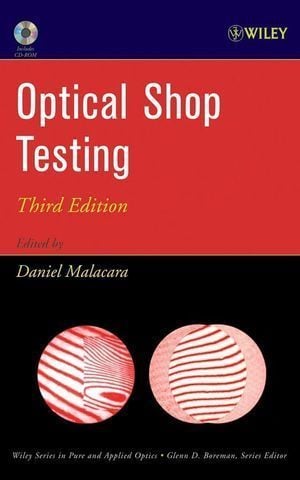
In the CD, which is included in the book, the reader will also find two programs for Windows, which may be useful when teaching or working in optical testing. One of these programs displays on the screen of the computer some of the most common interferogram types, test patterns, or transverse or wave aberration functions. These images as well as their associated numerical results can be saved in computer files. The other program helps in the design of phase shifting algorithms with the desired properties by using its Fourier mathematical representation.
Some classic chapters where no important recent advances have taken place remain almost the same, but most chapters are substantially modified, updated and enlarged, describing the most important new developments.
In the process of revising the book many important people have contributed, for example, the highly important work of authors of each chapter. A book like this would have been absolutely impossible without their fundamental contributions. The Editor is deeply thankful to all of them. Also, many other people, colleagues, and friends contributed with many constructive criticisms and suggestions and some times with hard work, preparing figures, or collecting references. The help of my secretary Marisa and my student Armando Gomez has been extremely useful. Finally, I cannot conclude without acknowledging the support and encouragement of my wife Isabel and all my family with whom I am indebted and grateful.
DANIEL MALACARA
 TABLE OF CONTENTS