Advanced Automotive Fault Diagnosis, Second Edition
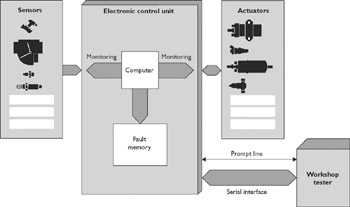
As the complexity of the modern vehicle continues to increase, developments in suitable test equipment must follow. Many mechanical and electronic systems now have ECUs, that contain self-diagnosis circuits. This is represented by Figure 3.1. On earlier systems this was done by activating the blink code output to access the information held in the ECU memory. This was done in some cases by connecting two wires and then switching on the ignition. It is now usual to read out the fault codes on a scanner.
Diagnostic techniques are very much linked to the use of test equipment. In other words you must be able to interpret the results of tests. In most cases this involves comparing the result of a test to the reading given in a data book or other source of information. By way of an introduction, the following table lists some of the basic words and descriptions relating to tools and equipment.
| Hand tools | Spanners and hammers and screwdrivers and all the other basic bits! |
| Special tools | A collective term for items not held as part of a normal tool kit. Or items required for just one specific job |
| Test equipment | In general, this means measuring equipment. Most tests involve measuring something and comparing the result of that measurement to data. The devices can range from a simple ruler to an engine analyser |
| Dedicated test equipment | Some equipment will only test one specific type of system. |