Advanced Automotive Fault Diagnosis, Second Edition
Chapter 10: Transmission Systems

10.1 Manual transmission

10.1.1 Clutch

A clutch is a device for disconnecting and connecting rotating shafts. In a vehicle with a manual gearbox, the driver pushes down the clutch when changing gear to disconnect the engine from the gearbox. It also allows a temporary neutral position for, say, waiting at traffic lights and a gradual way of taking up drive from rest.

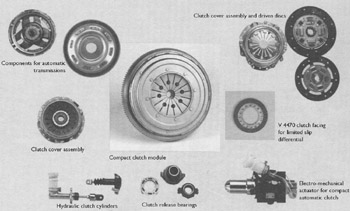
The clutch is made of two main parts, a pressure plate and a driven plate. The driven plate, often termed the clutch disc, is fitted on the shaft, which takes the drive into the gearbox. When the clutch is engaged, the pressure plate presses the driven plate against the engine flywheel. This allows drive to be passed to the gearbox. Pushing down the clutch springs the pressure plate away, which frees the driven plate. Figure 10.1 shows some typical clutch components including an electromechanical clutch actuator. The diaphragm type clutch replaced an earlier type with coil springs as it has a number of advantages when used on light vehicles:


Figure 10.1: Clutch components ( Source: Valeo)
  • not affected by high speeds (coil springs can be thrown outwards);

  • low pedal force making for easy operation;

  • light and compact;

  • clamping force increases or at least remains constant as the friction lining wears.

The method of controlling the clutch is quite simple. The mechanism consists of either a cable or hydraulic system.

10.1.2 Manual gearbox

The driver changes the gears of a manual gear- box by moving a hand-operated lever...

UNLIMITED FREE
ACCESS
TO THE WORLD'S BEST IDEAS

SUBMIT
Already a GlobalSpec user? Log in.

This is embarrasing...

An error occurred while processing the form. Please try again in a few minutes.

Customize Your GlobalSpec Experience

Category: Pneumatic Brake and Clutch Assemblies
Finish!
Privacy Policy

This is embarrasing...

An error occurred while processing the form. Please try again in a few minutes.