Advanced Automotive Fault Diagnosis, Second Edition

7.11: Fuel injection

7.11 Fuel injection

7.11.1 Introduction

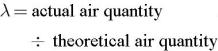
The ideal air fuel ratio is about 14.7:1. This is the theoretical amount of air required to completely burn the fuel. It is given a lambda ( ?) value of 1.


Air fuel ratio is altered during the following operating conditions of an engine to improve its performance, driveability, consumption and emissions:

  • cold starting richer mixture is needed to compensate for fuel condensation and improve driveability;

  • load or acceleration richer to improve performance;

  • cruise or light loads weaker for economy;

  • overrun very weak (if any) fuel, to improve emissions and economy.

The more accurately the air fuel ratio is controlled to cater for external conditions, then the better the overall operation of the engine.

The major advantage, therefore, of a fuel injection system is accurate control of the fuel quantity injected into the engine. The basic principle of fuel injection is that if petrol is supplied to an injector (electrically controlled valve), at a constant differential pressure, then the amount of fuel injected will be directly proportional to the injector open time.

Most systems are now electronically controlled even if containing some mechanical metering components. This allows the operation of the injection system to be very closely matched to the requirements of the engine. This matching process is carried out during development on test beds and dynamometers, as well as development in the car. The ideal operating data for a large number of engine operating conditions is stored in a...

UNLIMITED FREE
ACCESS
TO THE WORLD'S BEST IDEAS

SUBMIT
Already a GlobalSpec user? Log in.

This is embarrasing...

An error occurred while processing the form. Please try again in a few minutes.

Customize Your GlobalSpec Experience

Category: Combustion Engines
Finish!
Privacy Policy

This is embarrasing...

An error occurred while processing the form. Please try again in a few minutes.