Cargo Work: For Maritime Operations, Seventh Edition
Chapter 5: Tanker Cargoes

Introduction

At the present time modern civilization is largely dependent on oil and its by-products. Vast quantities of liquid products are transported by tankers throughout the world and, as such they have a high profile in the eyes of the general public. However, it should be realized from the outset that not all tankers are in the oil trade. Many transport wine or liquid chemicals, or liquid natural gas (LNG), but generally the tanker vessel is synonymous with the carriage of bulk oil or oil-based products.

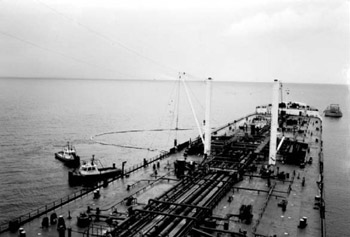
Concern for the environment, associated with tanker traffic, has become a number one priority in the anti-pollution campaign and rightly so (Figure 5.1). The marine industry must respect the environment and the well-being of the planet in which we all exist. To this end the Maritime Pollution (MARPOL) convention has gone some way to establishing standards of oil operations around the globe.


Figure 5.1: A tanker approaches a single buoy mooring (SBM) and prepares to pick up the floating oil pipe with the assistance of local tenders.

The main concern with the demands of a modern society has always been the costs of pollution scaled against societies' needs for oil. Those countries that have it need to go to market to strengthen national economy. While those that are without oil need to import to strengthen their economy. Clearly, an endless circle of world economics. Unfortunately, the tanker accident is not unheard of, e.g. the Amoco Cadiz , the Torrey Canyon , the Exxon Valdez and the...

UNLIMITED FREE
ACCESS
TO THE WORLD'S BEST IDEAS

SUBMIT
Already a GlobalSpec user? Log in.

This is embarrasing...

An error occurred while processing the form. Please try again in a few minutes.

Customize Your GlobalSpec Experience

Category: Fuels and Fuel Products
Finish!
Privacy Policy

This is embarrasing...

An error occurred while processing the form. Please try again in a few minutes.