Cargo Work: For Maritime Operations, Seventh Edition

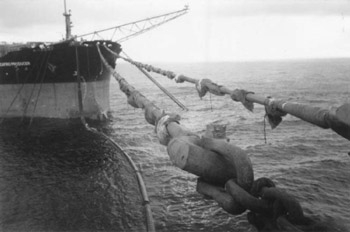
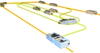
Loading of tankers takes place at jetties, from FSUs or from SBM. Where booms carrying oil-bearing pipes are to be connected, these will be insulated to prevent stray currents flowing, as from corrosion prevention systems employed on both ships and jetties. The flow of current in itself should not be a problem, but it may give rise to a spark when making or breaking connections to the manifold. For this reason, these sections are tested regularly for efficient insulation. Lines are often bonded to reduce static electricity effects which could also give rise to an unwanted source of ignition from the fast pumping of liquids (Figure 5.15).
These points are highlighted to illustrate that a high degree of awareness is required in all tanker operations whether loading, discharging or gas freeing. Fire precautions are paramount because the risk of fire aboard the tanker is a real hazard and stringent fire precautions must be adopted throughout cargo operations of every kind.
Company policy on loading procedures vary and Cargo Officers should adhere to the company procedures and take additional reference from the International Safety Guide for Oil Tankers and Terminals (ISGOTT):
Complete and sign the ship/shore checklist
Establish an agreed communication network
Agree the loading plan by both parties and confirm in writing
Loading and topping off rates agreed
Emergency stop procedures and signals agreed
All effected tanks, lines, hoses inspected prior to...