Cargo Work: For Maritime Operations, Seventh Edition
A text of this size cannot hope to cover every commodity or every situation that Ship's Officers encounter. Cargoes are varied and can be carried in many alternative forms. The following brief notes are meant to portray the fundamentals that go along with and support the various chapters and specifics expressed throughout this work.
A formal agreement to hire, rent or lease a ship. It is a private contract between two parties and may be written up in several formats, i.e. Time Charter, Bare Boat Charter or a Demise Charter.
Monies paid by the Charterer to the owner of the ship for delays in loading and unloading in accord with the terms of the Charter Party. The rate of demurrage is fixed and agreed between the owner and Charterer at the time of completing the Charter Party and cannot be altered. Can be taken in contrast with Despatch Money opposite to demurrage where the owner pays reward money to the Charterer for completing loading and/or discharging earlier than the expiry of Laytime .
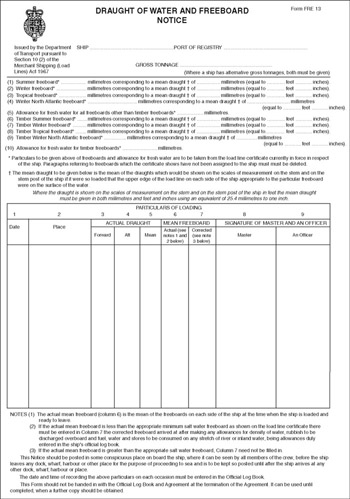
Following the completion of cargo operations in a port, the ship's draughts will expect to have changed. The draughts fore and aft should be read and the mean draught obtained.
It is a legal requirement that before the ship sails outward, the Freeboard Certificate is completed and displayed for the crew to see that the vessel is not overloaded and the minimum bow height is not exceeded (Figure A.1).