Cargo Work: For Maritime Operations, Seventh Edition
Measurement of liquid cargoes

The volume of oil in a tank is ascertained by measuring the distance from a fixed point on the deck to the surface of the oil. The distance is known as the ullage and is usually measured by means of a plastic tape. A set of tables is supplied to every ship, which indicate for each cargo compartment, the volume of liquid corresponding to a range of ullage measurements. The ullage opening is usually set as near as possible to the centre of the tank so that for a fixed volume of oil, the ullage is not appreciably affected by conditions of trim and list. If a favourable siting is not possible then the effects of list and trim should be allowed for (Figure 5.12).


Figure 5.12: Measurement of liquid cargoes.

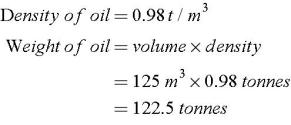
The important measure of oil is weight and this must be calculated from the volume of oil in each tank. Weight in tonnes is quickly found by multiplying the volume of oil in cubic metres by the relative density (RD) of the oil. This density is a fraction and may be taken out of petroleum tables when the RD of the oil is known.

To find the weight of 125 m 3 of oil at a RD of 0.98.


Oil expands when heated and its RD, therefore, decreases with a rise in temperature. In order that the weight may be calculated accurately, it is important that when ullages are taken the RD of the...

UNLIMITED FREE
ACCESS
TO THE WORLD'S BEST IDEAS

SUBMIT
Already a GlobalSpec user? Log in.

This is embarrasing...

An error occurred while processing the form. Please try again in a few minutes.

Customize Your GlobalSpec Experience

Category: Level Gauges
Finish!
Privacy Policy

This is embarrasing...

An error occurred while processing the form. Please try again in a few minutes.