Composite Structures, Design, Safety and Innovation

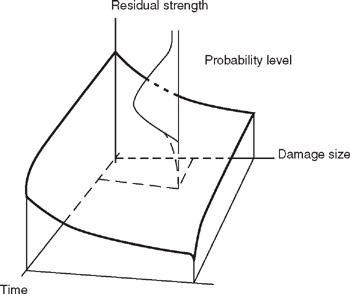
Damage in service is mostly the result of random events. Location of impact, shape of the impacting object, its size, its inertia, speed and direction are all random variables. The size and severity of damage are random variables. Residual strength is a function of damage size, severity and time. Figure 2.1 shows an "allowables-like" representation (with specific probability level). A probability density function is shown for a point in time and a specific damage size. This figure defines residual strength as a function of time. Damage growth and property degradation, due to environmental effects, depend on time. Consequently, safety level is a function of time.
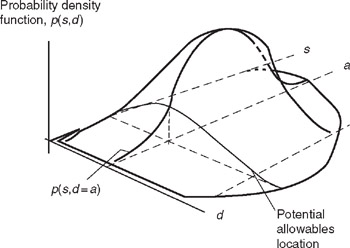
The design of a PSE requires either allowable values on predetermined probability levels or probability distributions (e.g. scaled up from coupon or element data). Figure 2.2 shows an example of a probability density function for damage size and residual strength.
The time effects can be introduced parametrically (in the probability density function once characterized). When the integrity definition contains damage range and strength limits, a quite manageable requirement can be imposed. The implied allowable value definition in Figure 2.2 could be made flexible based on what the specific PSE requires, and it could also be made global as the definition applies to material allowables.
The most effective way, in many cases, is to make it dependent on lay-up and t-bar (total area of a specific concept) and...