Composite Structures, Design, Safety and Innovation

The policy of innovation has often been expressed in terms of safety as:
"Composite Structure shall be as safe as or safer than the structure it replaces."
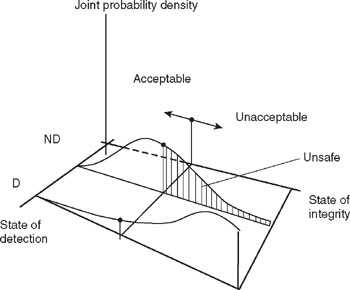
Objectives, like the one above, require an explicit measure of safety. Figure 5.1 illustrates the structural states that can be used as a basis for definitions of safe or unsafe structure.
The probability density has two "branches"; detected, D, or undetected, ND. The definition of an unsafe state is:
"An unsafe state is the state of undetected unacceptable integrity."
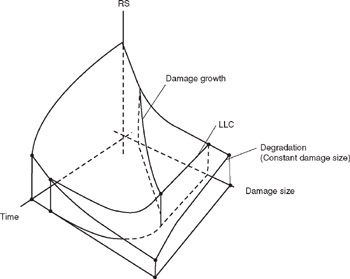
Structural integrity can be expressed in terms of residual strength, and Figure 5.2 contains a residual strength surface of a specific probability value.
Figure 5.2 shows the effect of time on residual strength. Figure 5.2 shows a limit load capability, LLC which should be the same as the limit load requirement, LLR. It also shows a growth curve that takes the PSE to unacceptable integrity by satisfying the inequality,
If we now ask: "What is the probability of an unacceptable integrity for a PSE which has n potentially critical locations and 5 damage size regions?" The answer could look like,
Figure 5.2 shows that both damage growth and degradation makes residual strength and consequently safety functions of time.
Figure 5.1 defines the Probability of "Unsafe Flight,"
which can be expanded to:
Eq. (5.1) is a measure of safety after a major inspection at T