Composite Structures, Design, Safety and Innovation

Appendix

A A MODEL OF ULTIMATE INTEGRITY

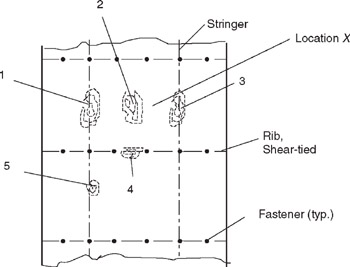
A design point for the sizing of a composite PSE is defined by a design model, a set of damage types and a policy for "bolted repair." It is assumed that ultimate integrity is a requirement even when damage tolerance is critical. We will study a case of composite skin-stringers in Example A.1, and we will use the basis for design shown in the "Design Model" in Figure A.1. Composites design situations, especially in compression, are much more complicated than what is the case in the "metal world."

The situation in Example A.1 involves three types of "weaknesses" (design focus). They are:

  • Permanent fasteners;

  • Fasteners of "bolted repairs;"

  • Accidental damage locations and types.

All these "weaknesses" can be present in the model in Figure A.1 (repairs are assumed present). Figure A.1 has five damage types, 1 5. They are:

  1. Debond between stringer and skin;

  2. Delamination in skin;

  3. Fiber and matrix breakage in skin and stringer flange;

  4. Fiber and matrix breakage in skin and shear-tie;

  5. Free stringer flange damage.

And fasteners are shown. All details are assumed to apply to location X. Figure A.1 includes events relating to fasteners, damage and repairs.

The probability of "acceptable ultimate integrity", AUI at location, X, U X can be written as,


Here we have (temporarily omitting the buckling integrity):

  • U F: AUI for all permanent fasteners;

  • U R: AUI for "bolted repairs";

  • U AD: AUI for all the accidental damage location involved.


Figure A.1:

UNLIMITED FREE
ACCESS
TO THE WORLD'S BEST IDEAS

SUBMIT
Already a GlobalSpec user? Log in.

This is embarrasing...

An error occurred while processing the form. Please try again in a few minutes.

Customize Your GlobalSpec Experience

Category: Flange Protectors
Finish!
Privacy Policy

This is embarrasing...

An error occurred while processing the form. Please try again in a few minutes.