Open VMS Operating System Concepts, Second Edition

A combination of general operating system theory and specific OpenVMS concepts makes this book interesting.
 TABLE OF CONTENTS
 It is convenient to describe a process as reading data, processing data, writing data, and then looping back to read more data. This single-user model is shown in operation over time (although without any particular time scale) in Figure 3.1. Chapter 1 hinted that the input/output (I/O) operations can easily dominate the execution time. Such a process is termed I/O-bound. or terminal-bound. On the other hand, if the process requires only a little I/O, and does a lot of computations between I/O operations, it is called computebound or CPU-bound. In any case, when the process is performing I/O, the processor is idle.
What is wrong with the picture in Figure 3.1? It is an economic problem: three equally expensive resources of the computer-the memory, the processor, and the I/O devices-should be fully utilized to achieve the best return on investment. However, the figure shows that much of the time, two of them, the processor and the I/O devices,are idle. And because it is not full, memory is sometimes underutilized too. This peculiar behavior was
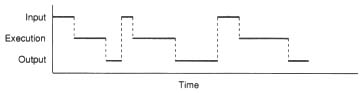
first noticed in the 1950s, and the obvious solution then was to have more than one process share the three resources. But a process must reside in memory (or in core, as memory was called then) in order to execute. Memory was expensive and therefore limited, so sharing was not very practical until the mid-1960s, when the price of memory began to drop...