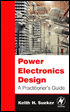
Power Electronics Design: A Practitioner's Guide
Chapter 1: Electric Power

Relative to the digital age, the electric utility industry may seem old hat. But power electronics and the power industry have a growing symbiotic relationship. Nearly all power electronics systems draw power from the grid, and utility companies benefit from the application of power electronics to motor drives and to converters used for high-voltage DC transmission lines. The two fields are very much in a state of constant development of new systems and applications. For that reason, a short review of the history and the present state of the electric utility industry is appropriate for consideration by the power electronics engineer.

1.1 AC versus DC

Take warning! Alternating currents are dangerous. They are fit only for powering the electric chair. The only similarity between an a-c and a d-c lighting system is that they both start from the same coal pile.

And thus did Thomas Edison try to discourage the growing use of alternating-current electric power that was competing with his DC systems. Edison had pioneered the first true central generating station at Pearl Street, in New York City, with DC. It had the ability to take generators on and off line and had a battery supply for periods of low demand. Distribution was at a few hundred volts, and the area served was confined because of the voltage drop in conductors of a reasonable size. The use of DC at relatively low voltages became a factor that limited the geographic growth of the electric utilities, but DC was well...

UNLIMITED FREE
ACCESS
TO THE WORLD'S BEST IDEAS

SUBMIT
Already a GlobalSpec user? Log in.

This is embarrasing...

An error occurred while processing the form. Please try again in a few minutes.

Customize Your GlobalSpec Experience

Category: Power Supplies
Finish!
Privacy Policy

This is embarrasing...

An error occurred while processing the form. Please try again in a few minutes.