Power Electronics Design: A Practitioner's Guide
Reactors of all types are the brethren of transformers. Iron-core reactors share the same characteristics as transformers as regards construction, insulation, and temperature ratings. Air-core coils are a more specialized class, often used in large sizes for outdoor harmonic filters or fault limiting, and in smaller sizes for di/dt limiting in equipment. Some general guidelines are shown in Table 7.3.
| Air core | Iron core |
|---|---|
| Linear inductance with current | Inductance may change with current |
| Generally high stray field | Stray field confined by core |
| Higher losses | Generally lower losses higher "Q" |
| No core needed | Core material suitable for frequency |
| Larger for given LI 2 | Smaller for given LI 2 |
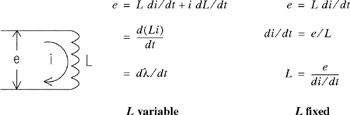
The basic equations for an inductive circuit section are shown in Fig. 7.18. The voltage is the derivative of the flux linkages, ?, the product of inductance and current. If the circuit inductance is constant, the equation becomes the familiar e = L di/ dt. Less appreciated sometimes in this simple circuit are the two other forms yielding di/ dt and L with a fixed inductance.
A simple equation for the inductance of a single-layer, air-core solenoid is shown in Fig. 4.19. The author came across this equation in a 1942 edition of a handbook he received as a high school graduation gift. The original source was the National Bureau of Standards, now the National Institute of Standards and Technology. It...