Power Electronics Design: A Practitioner's Guide

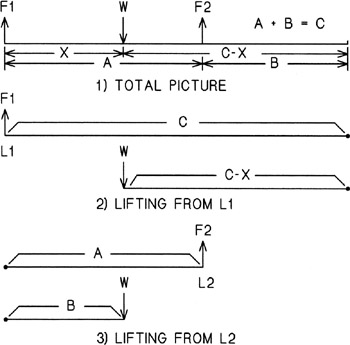
Lifting forces on cabinets for handling by a crane can be determined from measurements or calculation of the center of gravity and location of lifts. The basic consideration is that the moments about the pivot point must always balance. The pivot point is the cabinet end that remains on the floor with a single lift. One moment is the total weight, acting at the center of gravity, multiplied by the distance from the center of gravity to the pivot point. The other moment is the lifting force multiplied by the distance from the lift point to the pivot point. These two moments must always be equal. If the total weight and the center of gravity are known, the lifting forces can be calculated. If the two lifting moments are determined experimentally, the center of gravity and total weight can be calculated. The following example of a double lift may help. The lift forces F1 and F2 and their locations are presumed known, and the weight, W, and center of gravity, X, are to be found (Fig. B.1).
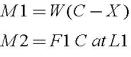
| Equating | W C W X = F1 C |
| M3 = W X | |
| M4 = F2 A at L2 | |
| Equating | W X = F2 A |
| Substituting | W C = F1 C + F2 A |
| Then | W = F1 + F2 A/C |
| And |