Power Electronics Design: A Practitioner's Guide

7.5: Eddy Current Effects

7.5 Eddy Current Effects

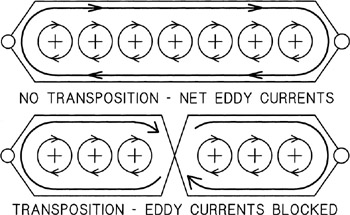
Parasitic eddy currents in the windings and core can have a major effect on transformer losses, especially in high-current transformers and those with nonlinear loads. Figure 7.9 shows the path of these currents in a conductor. The magnetic field, shown as a plus sign, is normal to the length of the conductor, and it induces voltages that cause tiny loops of eddy currents to flow. The voltages in adjacent cells cancel along the centerline. But the net of these loops is a current that flows down the length of the conductor on one radial side and back on the other. The result is an increase in the I 2R losses, because there is an excess of current over the normal load current.


Figure 7.9: Transposition to reduce eddy currents.

Transposing the conductor by making a half-twist in the middle of the length will reduce the net current, because the polarities of the induced voltages are opposite at the twist. High-current conductors are often made from two or three conductors arranged as a bifilar or trifilar set with transpositions. Eddy current losses are greatly reduced over a single large conductor of the same total cross section. Transpositions have been used since the earliest days of the telephone to reduce crosstalk and interference from power lines. Transpositions are often used on long transmission lines for phase balance.

Core iron is also a source of eddy current losses. In this case, the flux is in the plane of...

UNLIMITED FREE
ACCESS
TO THE WORLD'S BEST IDEAS

SUBMIT
Already a GlobalSpec user? Log in.

This is embarrasing...

An error occurred while processing the form. Please try again in a few minutes.

Customize Your GlobalSpec Experience

Category: RF Inductors
Finish!
Privacy Policy

This is embarrasing...

An error occurred while processing the form. Please try again in a few minutes.