Power Electronics Design: A Practitioner's Guide
7.6: Interphase Transformers

7.6 Interphase Transformers

Several precautions should be followed in specifying and using interphase transformers. The transformer must support the ripple voltage between the two half-wave sections of an SCR interphase converter circuit. But if the converter slews rapidly, the interphase must support a very much higher voltage during the transition. In an extreme case, the interphase transformer must support the entire line-to-line voltage from 60 to more than 150 . If it is designed to handle only ripple voltage, it will certainly saturate. One remedy is to limit the slew rate so that the transition is made over several cycles. The interphase transformer can also be gapped to saturate without damage, and a gap capable of supporting a DC unbalance of around 10% is a good safety feature.

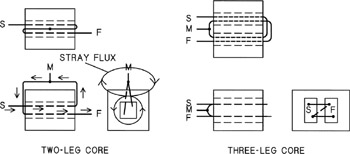
The interphase transformer design should also be considered. Figure 7.13 shows two-leg and three-leg core constructions for an interphase transformer. The two-leg design has no magnetomotive force (MMF) balance and will spew a large amount of leakage flux that has the potential for heating the floor or walls of a cabinet. It is sometimes used because it requires less iron than a three-leg core design. The three-leg design has cancelling fluxes from the conductors and has a minimum leakage flux. The small cost difference is good insurance against field problems.


Figure 7.13: Two- and three-leg interphase transformer cores.

UNLIMITED FREE
ACCESS
TO THE WORLD'S BEST IDEAS

SUBMIT
Already a GlobalSpec user? Log in.

This is embarrasing...

An error occurred while processing the form. Please try again in a few minutes.

Customize Your GlobalSpec Experience

Category: Single Phase Transformers
Finish!
Privacy Policy

This is embarrasing...

An error occurred while processing the form. Please try again in a few minutes.