Power Electronics Handbook: Devices, Circuits and Applications, Second Edition
Chapter 2: The Power Diode

Ali I. Maswood,
Ph.D.
School of EEE Nanyang Technological University,
Nanyang Avenue, , Singapore

2.1 Diode as a Switch

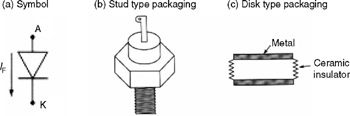
Among all the static switching devices used in power electronics (PE), the power diode is perhaps the simplest. Its circuit symbol is shown in Fig. 2.1. It is a two terminal device, and terminal A is known as the anode whereas terminal K is known as the cathode. If terminal A experiences a higher potential compared to terminal K, the device is said to be forward biased and a current called forward current ( I F) will flow through the device in the direction as shown. This causes a small voltage drop across the device (<1 V), which in ideal condition is usually ignored. On the contrary, when a diode is reverse biased, it does not conduct and a practical diode do experience a small current flowing in the reverse direction called the leakage current. Both the forward voltage drop and the leakage current are ignored in an ideal diode. Usually in PE applications a diode is considered to be an ideal static switch.


Figure 2.1: Power diode: (a) symbol; (b) and (c) types of packaging

The characteristics of a practical diode show a departure from the ideals of zero forward and infinite reverse impedance, as shown in Fig. 2.2a. In the forward direction, a potential barrier associated with the distribution of charges in the vicinity of the junction, together with other effects, leads to a voltage drop. This, in...

UNLIMITED FREE
ACCESS
TO THE WORLD'S BEST IDEAS

SUBMIT
Already a GlobalSpec user? Log in.

This is embarrasing...

An error occurred while processing the form. Please try again in a few minutes.

Customize Your GlobalSpec Experience

Category: Diodes
Finish!
Privacy Policy

This is embarrasing...

An error occurred while processing the form. Please try again in a few minutes.