Power Electronics Handbook: Devices, Circuits and Applications, Second Edition
Electronic ballasts, also called solid-state ballasts, are those power electronic converters used to supply discharge lamps. The modern age of electronic ballasts began with the introduction of power bipolar transistors with low storage time, allowing to supply fluorescent lamps at frequencies of several kilohertz and increasing lamp luminous efficacy by operating at these high frequencies. Later, electronic ballasts became very popular with the development of low cost power MOSFETs, whose unique features make them very attractive to implement solid-state ballasts. The main benefits of electronic ballasts are the increase in the lamp and ballast overall efficiency, increase in lamp life, reduction of ballast size and weight, and improvement in lighting quality. This chapter attempts to give a general overview about the more important topics related to this type of power converters.
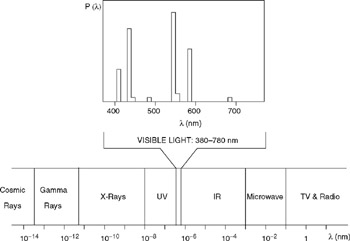
Discharge lamps generate electromagnetic radiation by means of an electric current passing through a gas or metal vapor. This radiation is discrete, as opposed to the continuous radiation emitted by an incandescent filament. Figure 22.1 shows the electromagnetic spectrum of an electric discharge, which consists of a number of separate spectral lines.
As can be seen in Fig. 22.1, only the electromagnetic radiation emitted within the visible region (380 780 nm) of the radiant energy spectrum is useful to provide lighting. The...