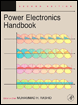
Power Electronics Handbook: Devices, Circuits and Applications, Second Edition
A continual endeavor in power electronics is to increase power density. This is achieved by shrinking component size, moving components closer, and reducing component count. During the last two decades, circuit frequencies increased sharply to shrink component dimensions. Improved thermal management and physical packaging materials brought components closer, and finally, increased integration of functions at the semiconductor and package levels reduced component count. This has been marked in the microelectronics world by "system on chip" (SOC), "system in package" (SIP), and "system on package" (SOP) with subsystems including "stacked die" and "multichip modules" (MCMs), all addressing higher densities and all applicable to lower power, power electronic systems.
The approach of "functional integration" has been ongoing for decades. Until the 1980s, nearly all such integration was done at the packaging level melding control and power processing. The term "smart power" (within the context of power electronic conditioning) applied in the 1960s 1970s to the integration of computers and microprocessors into large rectifier and converter cabinets. With the advent of high-voltage-silicon integrated circuits, more functionality was brought directly to the power semiconductors, and in the 1980s 1990s the term applied mostly to smart power semiconductors. In the late 1990s, there was a move back to hybrid integration following the trend to SOP. During the 1980s 1990s "smart power" also became associated with digital control of higher power systems, such as motor drives...