Properties of Crystalline Silicon

B. Pajot
April 1997
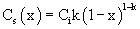
The equilibrium segregation coefficient k 0 of a solute in a substance is the ratio of its equilibrium concentration C 0s/C 0?, in the solid and the liquid near the liquid/solid interface. In the growth of silicon crystals from the melt by the Czochralski (CZ) method, the concentration C s(x) along the crystal axis of usual group III and group V dopants added to the melt follows the normal freezing law modelled by Pfann [1]:
| (1) | |
where C i is the initial dopant concentration in the melt and x the fraction of the melt solidified. As pointed out by Lin [2] the strong thermal convection in the silicon melt and small growth rates ensure that the measured segregation coefficient k for these dopants is usually the equilibrium value, except for elements with a high vapour pressure like Sb. For larger growth rates and for dopants with k 0 < 1, the value of the segregation coefficient has been found to increase. This is due to the large dopant concentration in the liquid near the solidification front, resulting from the segregation in the solid phase, which cannot readjust instantly to the equilibrium value. It has indeed been shown [3] that an effective segregation coefficient k eff larger than k 0 could be derived from the diffusion boundary layer thickness ?, the growth rate f and the diffusion coefficient D