Properties of Crystalline Silicon

(Edited by S.S. Iyer)
S.S. Iyer
June 1998
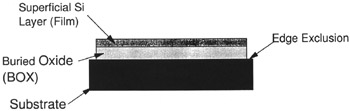
Silicon-on-insulator (SOI) refers specifically to a single crystal film of silicon on a dielectric film, usually silicon oxide. Thus, for the purposes of this chapter we specifically exclude the treatment of polycrystalline Si films grown on dielectrics. These are treated elsewhere in this volume. We also exclude epitaxial overgrowth techniques. From a materials perspective, SOI presents an interesting situation where we have a relatively perfect crystalline film in intimate contact with an amorphous film raising serious questions about heteroepitaxy in a situation of extreme lattice mismatch. The nature of the film and especially the interface is certainly intriguing and depends on the nature of the fabrication method. This unfortunately means that the properties of the superficial crystalline Si film depend to a large extent on the defect structure of the film and the extent to which these have been annealed out. Also, in most applications the films are thin, increasing the importance of the properties of the interface. For this reason, the method of fabrication of the SOI film plays a crucial role. FIGURE 1 identifies the key parts of an SOI wafer.
There are essentially two distinct methods of fabricating SOI. In the wafer bonding method, generally, two oxidised silicon surfaces are brought into intimate contact and through a thermally assisted chemical reaction, the oxides are fused. Thus, to a first order, the interfaces are the classic Si-SiO 2 interfaces and the...