Properties of Crystalline Silicon

M. Stavola
August 1997
The incorporation of hydrogen into silicon by diffusion is one of the properties of greatest interest, but it is also one of the most complicated. The diffusion constant for isolated H + appears to be well known, but the indiffusion of hydrogen into Si is made complicated by the existence of three charge states for hydrogen, interactions with other impurities, and the formation of slow diffusing hydrogen molecules. Here, results for the diffusion and solubility of isolated hydrogen are summarised first, followed by a qualitative discussion of the shapes of indiffusion profiles that result from hydrogen plasma treatment. Several critical reviews [1 5] on hydrogen diffusion and solubility have been written and should be consulted for information beyond the scope of the following survey.
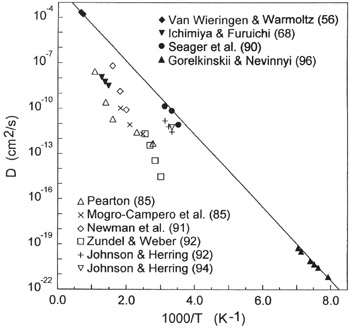
The earliest determination of the diffusion of hydrogen in Si was performed by Van Wieringen and Warmoltz (VWW) [6]. The permeation of hydrogen through thin-walled cylinders of Si was studied for the temperature range 1090 1200 C to obtain the following relationship for the diffusion coefficient:
| (1) | |
This relationship for the diffusivity is the most commonly used for isolated hydrogen and has been frequently extrapolated to room temperature. The diffusion coefficient given by EQN (1) is plotted in FIGURE 1 along with data points at 1090 and 1200 C.