Elements of Propulsion: Gas Turbines and Rockets
With worked examples, numerous homework problems, illustrations and pictures, this book provides a complete introduction to gas turbine and rocket propulsion for aerospace and mechanical engineers.
 TABLE OF CONTENTS
 The introductory fundamentals of aircraft propulsion systems are covered in this chapter. Emphasis is placed on propulsion systems that operate on the so-called Brayton cycle. Such systems include turbojets, turboprops, turbofans, ramjets, and combinations thereof. Before taking up the thermodynamic processes involved in these systems, we consider the forces acting on a propulsive duct and the effect of installation on the net propulsive force.
We define a propulsion system as a unit submerged in a fluid medium about and through which the fluid flows. The propulsion system contains an energy-transfer mechanism that increases the kinetic energy of the fluid passing through the system. This mechanism is called the engine. In Fig. 4.1, the engine is shown schematically in a nacelle housing that forms the second portion of the propulsion system. Thus the propulsion system contains:
An engine (the nozzle is considered to be part of the engine in our terminology),
Housing about the engine (nacelle or duct).
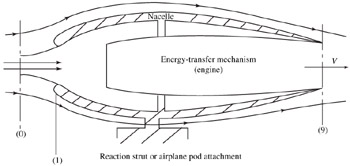
Several different aircraft systems may use the same engine submerged in different-shaped nacelles. Thus one propulsion system may use engine X in a pod installation hanging from a wing while, in another system, engine X may be surrounded by a nacelle that is, in fact, the airplane's fuselage examples are the F-15 vs F-16 propulsion systems that use the F-100 turbofan engine. The thrust of a propulsion system will depend on 1) its engine and 2) its nacelle.
As a result,...