Elements of Propulsion: Gas Turbines and Rockets

With worked examples, numerous homework problems, illustrations and pictures, this book provides a complete introduction to gas turbine and rocket propulsion for aerospace and mechanical engineers.
 TABLE OF CONTENTS
 Modern fighter aircraft and advanced bombers use the mixed-flow exhaust turbofan engine with afterburning like that shown in Fig. SM8.1. These engines have good fuel consumption when operated dry (afterburner off) and high specific thrust when the afterburner is turned on. This type of engine is normally designed with choked flow at stations 4, 4.5, and 8. The variable-area exhaust nozzle is controlled by the engine control system so that the upstream turboma-chinery is unaffected by the afterburner operation.
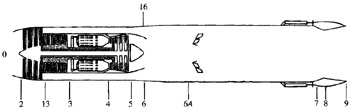
The mixing of the core stream and bypass stream in the fixed-area mixer adds six additional dependent variables to the performance analysis ( ? M, ? M, M 6, M 16, M 6 A, and ?'). Since the static pressures at stations 6 and 16 must be equal for operating conditions ( P 6 = P 16), the total pressure ratio of the two streams P t 6/ P t 16 will be near unity. This dramatically restricts the fan pressure ratio ? f and bypass ratio ? of this type of engine.
The independent variables, constant or known values, and dependent variables for the performance analysis of this engine cycle are listed in Table SM8.1. Note that for this engine, there are 14 dependent variables and 6 independent variables. As we will show for the choked exhaust nozzle,...



