Elements of Propulsion: Gas Turbines and Rockets

With worked examples, numerous homework problems, illustrations and pictures, this book provides a complete introduction to gas turbine and rocket propulsion for aerospace and mechanical engineers.
 TABLE OF CONTENTS
 We now consider a turbofan engine cycle with separate exhaust streams in which afterburning may operate in the core stream and duct burning may operate in the fan stream. When both the afterburner and duct burner are in operation, this engine cycle will give substantially higher specific thrust than the basic turbofan cycle, while still providing the low fuel consumption of the basic turbofan engine cycle when both the afterburner and duct burner are turned off. A sketch of this engine and the station numbering being used are shown in Fig. 5.1 in the testbook.
Analogously to the turbojet with afterburning, we define for the duct burner (DB)
| (SM7.1) |  |
| (SM7.2) | 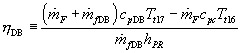 |
The assumptions for the analysis of the turbofan engine cycle with afterburning and duct burning are as follows:
Perfect gas upstream of main burner with constant properties ? c,R c, c pc, etc.
Perfect gas downstream of main burner with constant properties ? t, R t, c pt, etc.
Perfect gas downstream of afterburner with constant properties ? AB, R AB, c p AB etc.
Perfect gas downstream of duct burner with constant properties ? DB, R DB, c p DB, etc.
All components adiabatic (no turbine cooling).
The efficiencies of the compressor, fan, and turbine described through the use of (constant) polytropic efficiencies e c, e f, and e t, respectively.
The expression...



