Intangible Management: Tools for Solving the Accounting and Management Crisis

...there has been virtually no increase in the productivity of service work. Peter Drucker
Emotion and time studies enhance organizational performance by identifying how the organization is experiencing intangible costs and benefits. The purpose of emotion and time studies is to identify, value, and reduce time-based costs.
Waste neither time, nor money, but make the best use of both. Benjamin Franklin
As such, they are very different from time management as most people understand it (scheduling, to-do lists, priorities, etc.). For example, emotion and time studies would state "Attending this training seminar will cost you $450 in wages, productivity and other associated costs". Time management would inform you how to best organize your time before, during, and after the seminar. The two areas focus on time, but in very different ways.
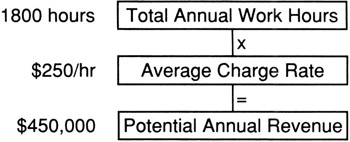
On average, each employee has a total of approximately 1800 working hours each year in which to apply their skills and talents. Consider a lawyer who can generate revenue of $250 per hour. If the lawyer has 1800 working hours, he can potentially generate $450,000 in revenue for the firm. These calculations are summarized in Figure 10.1.
In an ideal world, staff would be productive for the whole year. Common sense, and observation, informs us that this is not the case. Let us assume the employee charges out half of her available time to clients (900 hours). The other 900 hours are spent performing nonbillable...