IT Manager's Handbook: Getting Your New Job Done
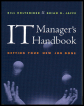
This is a how to be an IT manager book, and it covers every area possible and then some.
 TABLE OF CONTENTS
 Configuring a server includes the hardware configuration as well as the software configuration. Obviously, there are infinite parameters based upon the hardware and software you plan to use, the size of the operation, the specific needs and priorities, and so on. In fact, configuring the network operating system alone, which may have hundreds of parameters that can be set and tweaked, is the subject of entire books.
In this section, we'll talk about some high-level considerations when you configure the hardware for a server. We'll cover processor and memory, disk space, fault tolerance, backup, and support.
What processor you have in your server, how many of them, along with the installed memory, will be the primary impact on the device's performance. Your application vendor(s) should be able to give you some guidelines on these parameters based upon number of users, scale of environment, number of expected transactions, and so on. Many servers now can support a minimum of two processors, with others available for four, eight, and sixteen processors. Remember, adding more processing power may not do much if your application is I/O (i.e., disk reads and writes) intensive.
When considering the various trade-offs for your initial configuration, keep in mind options for later expansion. After all, it is likely you'll have this server for several years. It may not always be your primary machine, but you should be making a purchasing decision based on the fact that you...