IT Manager's Handbook: Getting Your New Job Done
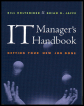
This is a how to be an IT manager book, and it covers every area possible and then some.
 TABLE OF CONTENTS
 Disaster recovery is like buying insurance; you're planning for the worst, but all the time hoping that it doesn't happen. IT disasters come in all shapes and sizes from easy-to-repair hardware failures, to blizzards that cause power outages, to terrorist attacks. You can't plan for every possible scenario, but you can still plan.
IT environments are replete with ways and technologies to deal with outages and failures: redundant servers, transaction logs, dial-up lines in case of leased line failures, tape backups, RAID disk drives, and on and on. The problem with these is that each can only handle the failure of a specific component. This leaves IT managers with the issue of what to do if the entire environment fails.
Be it fire, flood, earthquake, terrorism, weather, or the proverbial plane falling on the building, there is the remote chance that your organization could be completely inoperative for a significant length of time. As an IT manager, you need to plan on how you would restore...