IT Manager's Handbook: Getting Your New Job Done
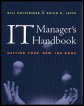
This is a how to be an IT manager book, and it covers every area possible and then some.
 TABLE OF CONTENTS
 A WAN (wide area network) refers to the network that connects the remote locations via telecommunications facilities (T-1 lines, ISDN, etc.). Unlike a LAN, a WAN can span large distances (such as cross-country). The network resourceswithin the locations of a WAN, by the way, are generally considered to be part of the LAN.
Designing a WAN is very similar to designing a LAN: you have to consider geography, traffic flow, and volumes. One of the key differentiators in LAN versus WAN issues is that the vast majority of LAN costs are up-front capital expenditures of cable installation and hardware. On the other hand, the vast majority of WAN costs are in recurring charges for lines.
You'll want to examine the expected traffic load between sites. Very often, the volume of data is directly proportional to the number of devices. But this isn't a hard-and-fast rule. The data center may have just a few devices (compared to the thousands of computers at corporate headquarters in the next state), but the volume of traffic to the servers in the data center would be quite high.
Additionally, you need to consider the type of traffic between sites. If the only data going between the sites is e-mail, the volume of data will be rather low. However, if large data files are being transmitted (e.g., multimedia or database replication), it will be a very high volume.
Other factors to consider: