Mixed Signal VLSI Wireless Design: Circuits and Systems
Chapter 2: Wireless Communication Systems Overview

2.1 INTRODUCTION

This chapter deals with the basics of wireless communication systems. A wireless communications system conveys information from a source, which is known as the transmitter to a destination, which is known as the receiver. In section 2.2, we describe the basic elements of a wireless communications system and their functions. In section 2.3, we present the Nyquist criteria required for inter-symbol interference free transmission. In this section, we also describe a popular class of filters used in wireless systems known as raised cosine filters. In section 2.4, we describe the Shannon limit, which gives the information capacity of a noisy channel, we present some channel coding techniques used to achieve the Shannon limit. Finally, in section 2.5, we consider the optimum receiver design to minimize the bit error rate across an additive white Gaussian noise channel.

2.2 DIGITAL COMMUNICATION SYSTEMS

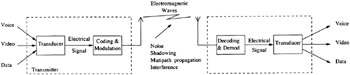
A wireless telecommunication system conveys information, such as voice, video or data from one location to another, by converting it into an electrical signal and eventually into an electromagnetic wave. Figure 2.1 shows a block diagram of such a system. At the transmitter side, a transducer converts the information signal (which could be a sound wave for example) into an electrical signal. The signal is then coded and modulated by the transmitter, eventually it is converted into an electromagnetic wave, and transmitted over a wireless channel to the receiver.


Figure 2.1: A wireless telecommunications system.

As the signal moves across the channel it suffers different types of impairments:

UNLIMITED FREE
ACCESS
TO THE WORLD'S BEST IDEAS

SUBMIT
Already a GlobalSpec user? Log in.

This is embarrasing...

An error occurred while processing the form. Please try again in a few minutes.

Customize Your GlobalSpec Experience

Category: Radio Transmitter ICs
Finish!
Privacy Policy

This is embarrasing...

An error occurred while processing the form. Please try again in a few minutes.