Mixed Signal VLSI Wireless Design: Circuits and Systems
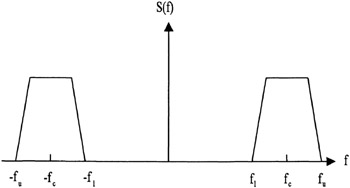
A band-pass signal is a signal whose frequency content is concentrated in a narrow-band that extends from f l to f u as shown in Figure 7.9. The band-pass signal has a center frequency f c given by:
| (7.16) | |
The bandwidth of the band-pass signal is 2 BW, where BW is given by:
| (7.17) | |
The sampling theory for band-limited signals, as given by equation 7.7, states that a sampling frequency of at least double the maximum frequency of the signal ( f s=2 f u) is needed to sample a band-limited signal. However, because of the band-pass nature of the band-limited signal, it is possible to sample it at a lower rate.
For every real band-pass signal m b (t), there exists an equivalent complex low-pass signal m l (t), having a bandwidth, BW, as given by equation 7.17. In the time domain, these signals are related by the following expression:
| (7.18) | |
Where,
* denotes the complex conjugate operation.
f c is the center frequency of the band-pass signal, which is given by equation 7.16.
Assume that M b (f) and M l (f) are the frequency transforms of m b (t) and m l (t) respectively. Hence, they are related by the following expression:
| (7.19) | |
The equivalent low-pass signal can be sampled at a minimum rate of f u ?f l for its real...