Mixed Signal VLSI Wireless Design: Circuits and Systems

A typical portable mobile terminal uses several electronic components such as: analog-to-digital converters, digital-to-analog converters, ASICs, DSPs, as well as active and passive RF components. The choice of a certain architecture and accordingly, the type and number of components used depends on the design constraints imposed on the designer and on the acceptable system performance.
The advancement in VLSI technology has dramatically impacted the development and advancement of wireless communication systems. On one hand, digital IC s are used for baseband and IF processing employing CMOS technology. While on the other hand, the front end RF portion of the transceiver is based on GaAs or Silicon Bipolar analog technologies. Silicon bipolar and/or CMOS technologies are employed in the intermediate amplifiers and up/down converters.
While IC technology will continue to play an important role in the affordability and versatility of wireless systems, it is important to focus on the current trends and endeavors in industry and academia that are going on to make this happen. The ultimate aim of these endeavors is to have a small, energy-efficient, low-cost and reliable mobile wireless system.
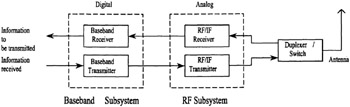
The signal processing functions performed by a wireless terminal can be classified into two subsystems as shown in Figure 8.1, the baseband subsystem and the radio frequency (RF) subsystem. Each subsystem has a different signal processing task which is reflected in the underlying architecture and the implementation technology.
The baseband subsystem operates on low frequency signals, with the signal...