Mixed Signal VLSI Wireless Design: Circuits and Systems

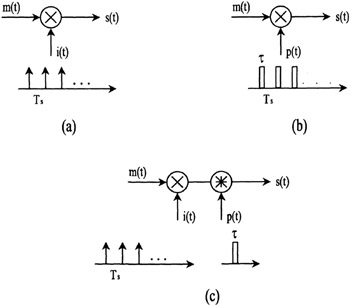
Sampling is the process of converting a continuous analog signal into a discrete-time signal or a sequence of numbers. Depending on the characteristics of the sampling circuit, sampling can be modeled differently, resulting in different frequency spectra for the sampled signal. In this section, we consider three sampling models as shown in Figure 7.5:
Ideal sampling. This is shown in Figure 7.5.a, the sampled signal is the product of the analog signal and an impulse train. This type of sampling is also known as impulse sampling or instantaneous sampling.
Pulse sampling. This is shown in Figure 7.5.b, the sampled signal is the product of the analog signal and a pulse train.
Flat-top sampling. This is shown in Figure 7.5.c, in this case, the sampler captures the value of the analog signal at a particular time instance, and then holds this value constant for the duration of the pulse. Flat-top sampling is modeled mathematically as multiplication by an impulse train followed by a convolution with a pulse.
Consider a band-limited low-pass signal m(t), as shown in Figure 7.6.a. Assume that M(f) is the frequency domain representation of that signal. Suppose that we want to sample this signal every T s seconds, this is achieved by multiplying the continuous input signal m(t) by an infinite impulse train i(t)