Mixed Signal VLSI Wireless Design: Circuits and Systems
Spread spectrum is a wireless communication technique that uses a transmission bandwidth, which is many times larger than the data rate. It has been used for military applications since the 40 s. Its anti-jamming properties coupled with the fact that it allows the transmission of information hidden in the background noise makes it suitable for military purposes, where it is desired to make the transmitted signal hard to detect by the enemy.
Recently, spread spectrum techniques have been applied to civilian applications for mobile telephone systems, where it is used as a multiple access communication technique that allows a large population of users to share a common channel. Furthermore, spread spectrum uses frequency diversity to combat the fading effects of the wireless multi-path environment.
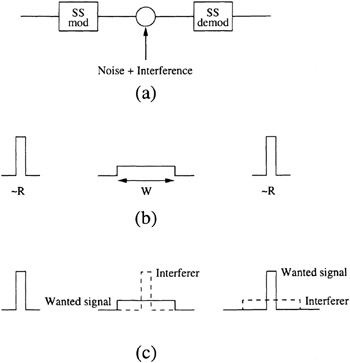
The spread spectrum modulator spreads the information signal to a signal having a much larger bandwidth, as shown in Figure 5.1.b. The spreading process is done by a Pseudorandom Noise (PN) sequence, which is a high rate code having a much higher rate than that of the information signal. The transmitted signal appears to other users as noise. However, to the intended receiver, the wideband received signal is despread, using a PN sequence synchronized with that of the transmitter, such that the signal is despread to an identical replica of the transmitted signal, as shown in Figure 5.1.b.
Figure 5.1.c shows the ability of the spread spectrum system to...