Pipeline Risk Management Manual: Ideas, Techniques, and Resources, Third Edition
The following is a summary of the risk evaluation framework described in Chapters 3 through 7. It is one of several approaches to basic pipeline risk assessment in which the main consequences of concern are related to public health and safety, including environmental considerations. Regardless of the risk assessment methodology used, this summary can be useful as a checklist to ensure that all risk issues are addressed.
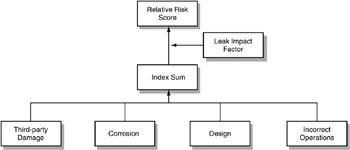
| Relative Risk Rating | = | (Index Sum) (Leak Impact Factor) | ||
| Index Sum | = | [(Third Party) + (Corrosion) + (Design) + (Incorrect Operations)] | ||
| Third-Party Index | ||||
| A. | Minimum Depth of Cover | 0 20 pts | 20% | |
| B. | Activity Level | 0 20 pts | 20% | |
| C. | Aboveground Facilities | 0 10 pts | 10% | |
| D. | Line Locating | 0 15 pts | 15% | |
| E. | Public Education | 0 15 pts | 15% | |
| F. | Right-of-Way Condition | 0 5 pts | 5% | |
| G. | Patrol | 0 15 pts | 15% | |
| 0 100 pts | 100% | |||
| Corrosion Index | ||||
| A. | Atmospheric Corrosion | 0 10 pts | 10% | |
| A1. | Atmospheric Exposures | 0 5 pts | ||
| A2. | Atmospheric Type | 0 2 pts | ||
| A3. | Atmospheric Coating | 0 3 pts | ||
| B. | Internal Corrosion | 0 20 pts | 20% | |
| B1. | Product Corrosivity | 0 10 pts | ||
| B2. | Internal Protection |