Surge pressures, often called waterhammer, are caused when a moving fluid is suddenly brought to a stop. The resulting translation of kinetic (moving) energy to potential energy causes an increase in the internal pressure the creation of a pressure wave. An associated positive and negative pressure wave will travel in both directions along the pipe, reflecting and overlapping, depending on the system configuration.
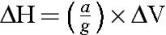
The magnitude of the pressure increase is found with the following equation [55]. Surge pressure in feet of water is readily converted to psig by multiplying by 0.43 psig/feet of water:
where
-
? H = surge pressure (feet of water)
-
a = velocity of the pressure wave (ft/sec)
-
g = acceleration due to gravity (32 ft/sec 2)
-
? V = change in velocity of fluid (ft/sec)
We can see from this equation, that the magnitude of the pressure surge is directly related to the speed of the pressure wave and the fluid velocity change.
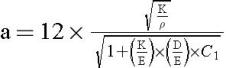
To calculate the speed of the pressure wave in the pipe, we can use the following equation [55]:
where
-
a = pressure wave velocity (ft/sec)
-
K = bulk modulus of the fluid (lb/in. 2)
-
? = density of the liquid (slugs/ft 2)
-
D = internal diameter of pipe (in.)
-
t = pipe wall thickness (in.)
-
E = modulus of elasticity of pipe material (lb/in. 2)
-
C 1 = constant dependent on pipe constraints.
We can see from this equation that pressure wave speed is dependent on pipe...
Copyright Elsevier Inc. 2004 under license agreement with Books24x7


 TABLE OF CONTENTS