Pipeline Risk Management Manual: Ideas, Techniques, and Resources, Third Edition
| Third-Party Damage Index | |||
| A. | Minimum Depth of Cover | 0 20 pts | 20% |
| B. | Activity Level | 0 20 pts | 20% |
| C. | Aboveground Facilities | 0 10 pts | 10% |
| D. | Line Locating | 0 15 pts | 15% |
| E. | Public Education Programs | 0 15 pts | 15% |
| F. | Right-of-Way Condition | 0 5 pts | 5% |
| G. | Patrol Frequency | 0 15 pts | 15% |
| 0 100 pts | 100% |
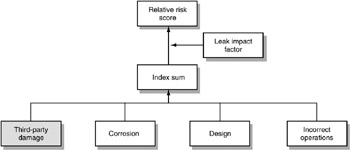
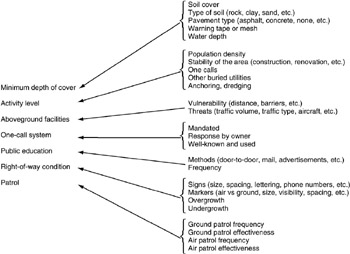
This table lists some possible variables and weightings that could be used to assess the potential for third-party damages to a typical transmission pipeline (see Figures 3.1 and 3.2).
Pipeline operators usually take steps to reduce the possibility of damage to their facilities by others. The extent to which mitigating steps are necessary depends on how readily the system can be damaged and how often the chance for damage occurs.
Third-party damage, as the term is used here, refers to any accidental damage done to the pipe as a result of activities of personnel not associated with the pipeline. This failure mode is also sometimes called outside force or external force, but those descriptions would presumably include damaging earth movements. We use third-party damage as the descriptor here to focus the analyses specifically on damage caused by people not associated with the pipeline.