Pipeline Risk Management Manual: Ideas, Techniques, and Resources, Third Edition

| Leak Impact Factor Overview | |||
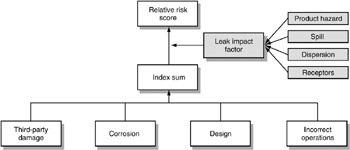
| Leak impact factor (LIF) = product hazard (PH) leak (L) dispersion (D) receptors (R) | |||
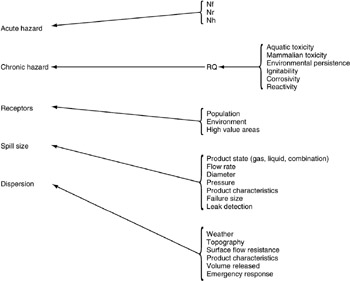
| A. | Product Hazard (PH) (Acute + Chronic Hazards) | 1 22 pts | |
| A1. | Acute Hazards | ||
| a. | Nf | 0 4 pts | |
| b. | Nr | 0 4 pts | |
| c. | Nh | 0 4 pts | |
| Total (N f + N r + N h) | 0 12 pts | ||
| A2. | Chronic Hazard (RQ) | 0 10 pts | |
| B. | Leak/Spill Volume (LV) | ||
| C. | Dispersion (D) | ||
| D. | Receptors (R) | ||
| D1. | Population Density (Pop) | ||
| D2. | Environmental Considerations (Env) | ||
| D3. | High-Value Areas (HVA) | ||
| Total Receptors = (Pop + Env + HVA) |
Note: The leak impact factor is used to adjust the index scores to reflect the consequences of a failure. A higher point score for the leak impact factor represents higher consequences and a higher risk.